.png)


.png)
.png)

They’re Ordinary. And That’s the Problem.
For many households, financial stress doesn’t begin with disaster. It begins with everyday expenses they weren’t prepared for.
When people imagine a financial setback, they often picture something dramatic.
A market crash.
A major medical emergency.
A sudden bankruptcy.
Some huge, once-in-a-lifetime event that turns everything upside down.
But that is not usually how financial stress enters a household.
More often, it shows up through ordinary life.
A car repair.
A home issue.
A missed payment.
A medical bill.
A reduction in income.
Not dramatic. Just disruptive.
Most Money Problems Begin in Everyday Life
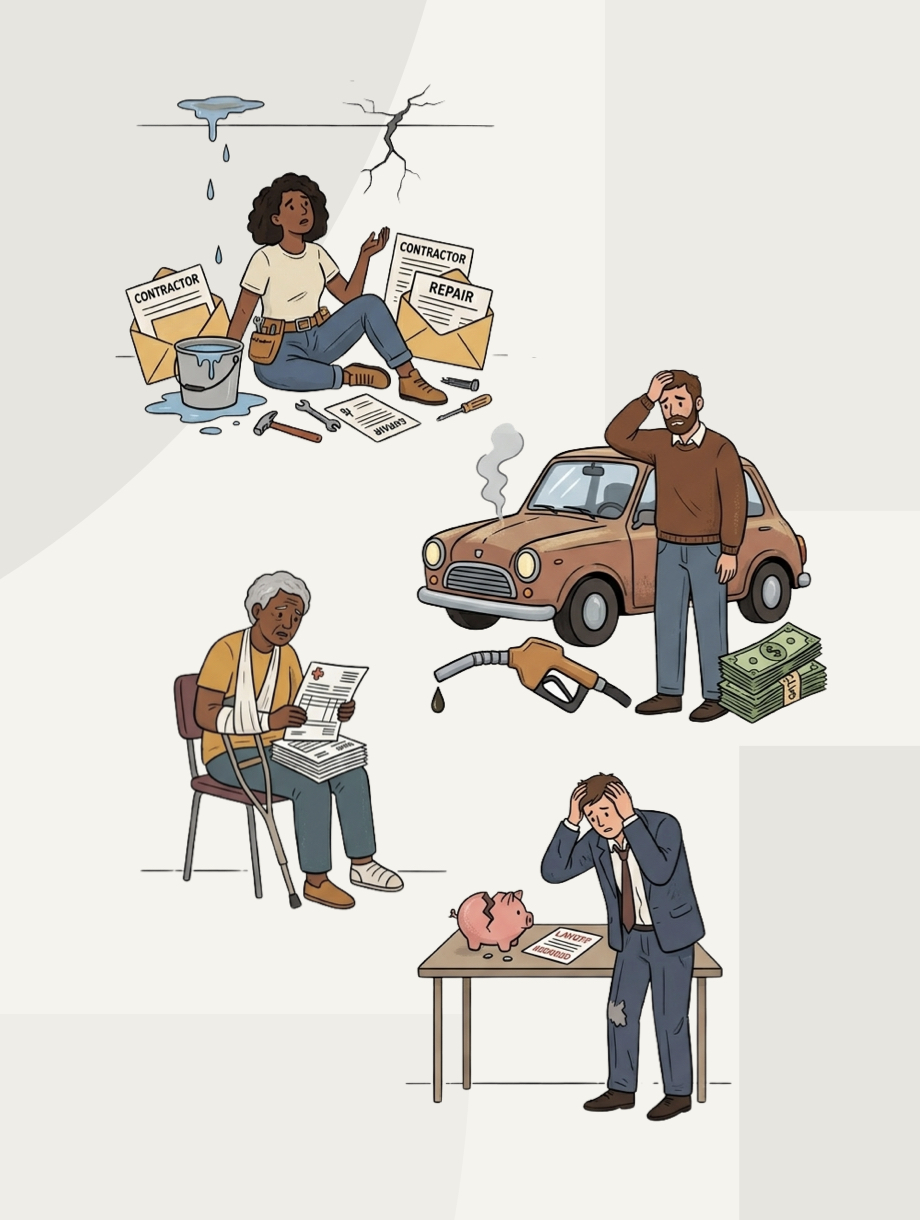
And according to a recent National Endowment for Financial Education report, that is exactly what happened to many Americans in 2025. The major expenses or unexpected setbacks reported by households included unexpected transportation expenses (25%), unexpected home repairs or maintenance (24%), falling behind on bill payments or debt obligations (22%), medical expenses due to injury or illness (21%), and job loss or significant reduction in income (20%).
That list is revealing.
These are not exotic financial disasters. These are the kinds of things that happen in normal life. Which means the real issue is not just whether problems happen. It is whether people are financially prepared when they do.
Ordinary Disruptions Become Expensive Fast
And that is where financial literacy becomes so important.
At TheMoneyBooks, we believe one of the greatest misunderstandings about money is that people think financial literacy is only for investing, retirement, or advanced planning. But financial literacy matters much earlier than that.
It matters when you are deciding how much debt to carry.
It matters when you are choosing how to structure your monthly expenses.
It matters when you are trying to build margin into your life.
It matters when you are deciding whether to spend, save, borrow, or protect.
In other words, financial literacy matters most in everyday life.
Because everyday life is where most financial setbacks begin.
The Small Things That Throw People Off Track
Think about transportation costs. A blown transmission, unexpected repairs, new tires, a breakdown that interrupts work, or rising insurance and maintenance costs can quickly throw off a budget. Home-related expenses can do the same. A leak, appliance replacement, HVAC issue, plumbing repair, or maintenance problem can turn into a costly surprise.
Then there are the more painful disruptions. Falling behind on bills. Medical costs. Reduced income. These are not merely line items. These events create emotional pressure too. They can make people feel cornered, embarrassed, and overwhelmed.
Without a Financial Framework, Everything Hits Harder
That is the danger of living without a financial framework.
When money is unclear, every disruption hits harder.
Without a budget, it is hard to know what can flex and what cannot.
Without savings, every surprise feels like a threat.
Without an understanding of debt, people often solve today’s problem by creating a bigger one for tomorrow.
Without guidance, many people just patch things together and hope relief comes before the next setback.
That is not peace. That is survival mode.
And survival mode is exhausting.
Financial Literacy Should Never Be Framed as Judgment
What makes this even more important is that many people experiencing these setbacks are not irresponsible. They are simply underprepared, undereducated, or trying to manage too much pressure at once. That is why financial literacy must never be framed as judgment. It should be framed as empowerment.
Education gives people options.
It helps them think ahead instead of always reacting.
It helps them spot risk before risk becomes damage.
It helps them prepare for life’s ordinary disruptions, which are often the very things that become extraordinary burdens.
This Is Why Financial Literacy Month Matters
That is one reason Financial Literacy Month matters so much. It reminds us that education is not just about the future. It is about resilience in the present.
When someone understands the basics of cash flow, debt management, budgeting, emergency savings, and financial protection, they are better positioned for real life. Not perfect life. Real life.
And real life is exactly where so many households are struggling.
People Want More Than Relief. They Want Control
The NEFE report also found that the most common financial resolutions for 2026 are paying down debt (42%), setting and following a budget (39%), and checking and improving credit score (36%). That tells us something powerful. People do not just want relief. They want control. They want to fix the fundamentals.
That is encouraging.
It means many people already know the answer is not another shortcut. It is a stronger foundation.
They want to understand where their money is going.
They want to stop losing ground.
They want to rebuild confidence.
They want to make better decisions.
And that is exactly where financial literacy can make a lifelong difference.
Understanding Money Should Not Feel Out of Reach
At TheMoneyBooks, we believe understanding money should not feel out of reach. It should not feel like insider knowledge. It should not require a finance degree just to make wise decisions about debt, spending, saving, and planning.
People deserve clear, practical, usable financial education.
Because the consequences of not understanding money are often hidden at first. A little debt here. A missed payment there. A delayed repair. A decision that seems manageable in the moment. But over time, those ordinary decisions begin to stack. That is how people wake up one day and realize stress has become their normal.
The Goal Is to Be Ready for Real Life
Financial literacy interrupts that pattern.
It helps people recognize the cost of delay.
It helps them prioritize what matters most.
It helps them build the habits that create long-term stability.
That is not flashy, but it is powerful.
This Financial Literacy Month, the goal should not be to overwhelm people with financial information. The goal should be to help them understand the issues that touch daily life. Because that is where the real battle is being fought.
Not in theory.
In the kitchen.
In the car.
In the monthly budget.
In the emergency.
In the bill that came too soon.
In the decision someone did not feel prepared to make.
That is why ordinary setbacks matter so much. They reveal whether a person has a system, or just stress.
And for millions of Americans, the answer right now is stress.
But that can change.
Understanding money changes how people respond to life. It does not eliminate every problem, but it helps prevent ordinary setbacks from turning into long-term financial pain.
Call to action:
This Financial Literacy Month, do not wait until the next surprise expense forces your attention. Take the Financial Literacy Quiz and find out where your understanding stands. Then connect with a financial educator who can help you build a stronger foundation for real life.