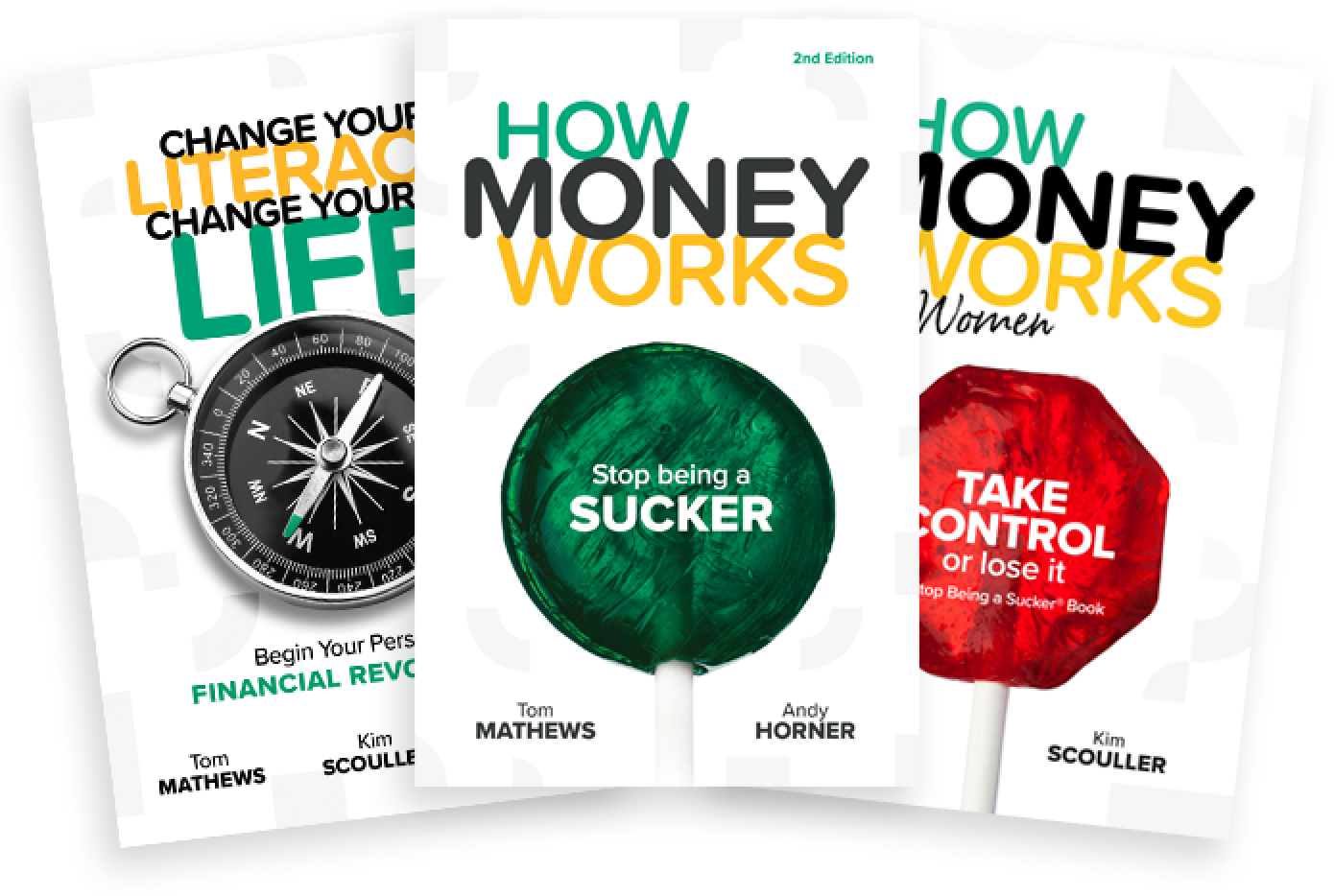
 Request a copy of our book(s)
No One Has Money

No one has money. You may think other people have money, but they don’t.
For each generation, it’s the same.
They don’t get taught how money works from K-12.
High school graduates head off to college. They don’t learn how money works there, either.
College graduates enter the workforce and start earning a paycheck… and spending their paycheck.
Soon, they enter a cycle of foolish spending. Earn a paycheck. Spend a paycheck. Earn a paycheck. Spend a paycheck.
They join the hundreds of millions living paycheck-to-paycheck. Always spending. Barely saving, if at all.
When retirement finally arrives or accidents or illness occur later in life, a terrible realization dawns on them…
They have no money.
According to a recent survey…¹
◼ Gen Z adults have saved an average of $37,000 for retirement
◼ Millennials have saved an average of $63,300 for retirement
◼ Gen-Xers have saved an average of $98,900 for retirement
◼ Baby Boomers have saved an average of $138,900 for retirement
Only Gen Z and Millennials are even close to being on track for retirement. Gen-Xers and Baby Boomers fall short of bare minimum savings by over half.
It’s not for lack of income—many Americans make enough to put their money to work.
Rather, it’s because they lack knowledge. They just don’t understand how money works beyond earning and spending.
The takeaway? If you’re a Gen-Xer or Baby Boomer, the time to start building wealth is now.
But for your income and skills to translate into wealth, you need tools. You need concepts like…
◼ The Power of Compound Interest
◼ The Time Value of Money
◼ Wealth Equivalency
These concepts will help you answer questions like…
◼ What interest rate do I need to close the gap between my savings and my retirement goals?
◼ How much do I need to save each month to retire with $1 million?
◼ Should you save a nest egg or start a business?
If those are answers you need to get, ask me how you can learn. I’d be happy to introduce you to resources that can set you on the right path towards discovering how money works and building wealth.
Protecting Your Emergency Fund From Inflation

Your emergency fund may be rapidly losing value.
Despite your best efforts and planning, you and your family’s first line of financial defense might be eroding day by day. And it’s all because of inflation.
Here’s what’s happening…
Inflation is the steady increase of prices over time. A jug of milk that costs $2.85 one year could cost $3.00 the next. On average, prices have inflated at 3.25% annually since 1914.¹
But in 2021, inflation exploded. The market faced a perfect storm of low interest, pandemic-fueled supply chain problems, and consumers returning to stores. Demand soared while supply shrank.
The result? Consumer prices increased 7% in 2021, the highest rate since 1982.²
That means everything is increasing in price… including the services you need in emergencies.
But here’s the problem—it’s a challenge for your emergency fund to outgrow inflation.
Why? Because above all else, your emergency fund must be both accessible and stable. What good is an emergency fund if you can’t use it in a pinch or if it gets leveled by market fluctuations?
And good luck finding an account that’s accessible, stable, AND pays interest that’s greater than inflation. In today’s climate, it can be difficult to find a “high interest” savings account that pays more than .5%. Read that again. Not 5%. Point 5 percent.
The question then, isn’t if your emergency fund can outgrow inflation. It’s about minimizing the damage.
Here are two ideas that may make the difference between financial success and disaster in the face of emergencies…
Increase your income. It’s simple—the more you earn, the better positioned you are to navigate emergencies. Look for ways to increase your income through side hustles, a new opportunity, or even negotiating higher wages with your current employer.
Just remember—not all sources of income are created equal. The income from your job, for instance, has two critical weaknesses…
- It may dry up if an emergency stops you from working
- Wages haven’t kept pace with inflation for decades
In short, the best sources of income for emergencies work even when you can’t, and empower you to control your own wage.
Some options are…
Turning a hobby or passion into a side-hustle Starting a business that eventually becomes self-sustaining Creating and selling duplicatable items like books, courses, music, etc.
Split your emergency fund. If you have a substantial emergency fund you could split it between two accounts. One half would grow slowly but remain easily accessible and stable. The other half would grow faster but be less accessible and more volatile.
Be warned—this strategy will only work if you have substantial emergency savings. Before you opt for this approach, consult with your financial professional.
Shielding your emergency fund from inflation is possible, but it takes the right strategy. It’s always wise to consult with a licensed and qualified financial professional before committing to a strategy.
Will Your Savings Become Wealth?

Not sure if you’re on track to become wealthy? The Rule of 72 can help!
The Rule of 72 is a simple mental math shortcut that estimates how long it could take your money to double. This is what it looks like…
72 ÷ interest rate = years to double
It’s simple, it’s easy, and it might change your life.
Here’s how…
Let’s say you’re done living paycheck-to-paycheck and you’re ready to build wealth. You’ve downloaded a budgeting app, and you’ve set aside $150 each month to save. Look at you! That’s a massive step towards building wealth.
But now you face a dilemma—where should you stash that money each month?
Your checking account? A savings account? Retirement accounts? NFTs? Each person you ask has a different opinion, fully backed with anecdotal evidence.
But have no fear! Enter the Rule of 72. It’s your gleaming sword that can slash through false perceptions and help you conquer your savings goals.
Let’s say for the time being, you’ve kept some money in a “high-interest” savings account earning .5%. How quickly will that account double your money?
Simple—plug that interest rate into the Rule of 72, and you get…
72 ÷ .5 = 144 years to double…
That’s right—your money will take 144 years to double with your current savings strategy. Yikes! That’s enough time to move from steam power to SpaceX.
But that’s not all—that interest rate leaves you helpless to inflation, which as of the writing of this article is about 3.25%.1 Luckily, you can use the Rule of 72 to discover when inflation will double the cost of living. Just replace the interest rate with the rate of inflation, and you get…
72 ÷ 3.25 = 22 years
Think of it like this—in 144 years, your money would double once. But the cost of living would double 6 times. Without the Rule of 72 to reveal this truth, your savings strategy might erode your wealth instead of increasing it!
But suppose you found an account with a 6% interest rate. Plug that into the Rule of 72, and you get a very different result…
72 ÷ 6 = 12 years
Over a 45 year career, your money would double roughly 3 times. The cost of living would only double twice. So your wealth would be above the rising tide of inflation.
The Rule of 72 isn’t a guarantee of success. After all, past performance can never guarantee future results. But the Rule of 72 can estimate if your savings are on track to become wealth, or if you’re heading towards financial disaster. Use it often, and discuss your findings with a financial professional.
Be Like Buffett

Warren Buffett didn’t become a billionaire overnight. Instead, he leveraged simple concepts over decades to build a vast fortune.
These are the same concepts you can use too.
To demonstrate this, let’s review the history of Buffett’s wealth…
Buffett started growing his money at age 11. He bought three stocks at about $38 a piece.¹
By the age of 30 he had become a millionaire.²
He didn’t become a billionaire until age 56.³
But the vast majority of his wealth wasn’t created until he was past the normal retirement age.
Over the next 36 years, his wealth surged to over $100 billion.⁴ If you include the $37 billion he’s donated,⁵ his net worth increased over 10,000%.
That’s a staggering figure.
And it’s all because he leveraged two simple concepts—the Power of Compound Interest and the Time Value of Money.
The Power of Compound Interest explains the exponential growth of Buffett’s net worth. Buffett used money to earn money. The more money he made, the more he could also earn.
By the time he was 57, he had $1 billion at his disposal to build further wealth. In short, he unlocked a virtuous cycle of growth leading to greater growth.
But it’s the Time Value of Money that explains Buffett’s massive success.
Compounding requires time to get the maximum benefits. The longer money compounds, the greater its ability to build wealth.
And Buffett started compounding early. Very early. Age 10, to be precise.
What if he had started later? Let’s suppose he started at age 30 with $25,000, earned 22% annually (Buffett’s career average), and retired at age 60 to play golf.
His net worth in this scenario? $11.9 million. 99.9% less than his current value.⁶
The takeaway? Be like Buffett.
That doesn’t mean going down the finance nerd rabbit hole. It definitely doesn’t mean adopting the Oracle of Omaha’s diet of fast food and soda!
Instead, leverage the Power of Compound Interest ASAP. Then, be patient and let the Time Value of Money work its magic over years and decades. And rest easy—you’re following in the footsteps of the greats.
The Scandal of the American Financial Education System

The scandal of the American financial education system is that there is no American financial education system.
It doesn’t exist. And millions are suffering for it.
As it stands, only 21 states require financial education courses to graduate high school.¹ But that number is a mirage—60% of students in those states haven’t actually taken the classes!²
Simply put, almost no one in America is learning how money works. And it’s wreaking havoc on the lives of millions.
Would these statistics even exist if schools empowered students with financial literacy? You be the judge…
• $167 billion wiped out by foolish investments in meme stocks in early 2021³
• Over $1 trillion lost to volatile cryptocurrencies in a single week⁴
• Over $1 trillion in student loan debt shackling Americans⁵
• 1/3 of millennials believe they’ll never have enough saved to retire⁶
These numbers tell a story.
Students go through high school without hearing a peep about how to manage money or build wealth.
They sign off on student loans without being taught how debt can devastate their future.
Graduation comes around, and they start living paycheck to paycheck. How could they not? It’s all they know.
And then, no surprise, they’re suckered into get-rich quick scams that promise wealth but only deliver crushing losses.
Do these scenarios hit a bit too close to home? If they do, then know this—you cannot rely on the powers that be to show you how to change your story.
If you were let down by your school system—and even if you weren’t—ask me for a copy of How Money Works: Stop Being a Sucker. It may be the knowledge you need to turn your financial situation around and change your future.
Closing The Gap

Women earn 83¢ for every $1 earned by men.¹
The median annual salary for men is around $61,100. At 83¢ for every $1 earned by a man, the median annual salary for women is around $50,700.² For someone taking care of a family, how significant do you think that extra $10,000 would be?
By the time a woman reaches age 65, she will have earned $900,000 less than a man who stayed continuously in the work force.³ Consequently, retired women receive only 80% of what retired men receive in Social Security benefits.⁴
Women tend to be the primary caregivers for their children, parents and partners.¹ So women end up taking time away from their careers to care for loved ones.
These career interruptions can significantly impact women’s chances to climb the corporate ladder – promotions, raises, bonuses and full retirement benefits.³
Since women earn less, we have less money to set aside for our financial goals. Of the Americans who live paycheck to paycheck, is it a surprise that 85% are women?⁵ As a result, women own just 55¢ for every $1 owned by men. We accumulate only half of the wealth accumulated by men.⁶
We may not see the gender pay gap or the gender wealth gap close in our generation. But women can change the financial trajectory of their lives by learning how money works and applying the 7 Money Milestones. By understanding and paying attention to all of the things that make up our financial picture – Financial Education, Proper Protection, Emergency Fund, Debt Management, Cash Flow, Build Wealth, and Protect Wealth, we have the power to take control over our financial future and create equal wealth for ourselves.
And, women need to think about their career decisions. We should consider choosing a career that pays more to women and men equally. With a company that doesn’t penalize women for time spent taking care of loved ones. A place where women can create equal pay for ourselves.
Women have made a lot of progress in pursuing higher education and professional careers, but we’ve only made incremental progress in our finances. If we want to bring about profound change, we have to make it happen for ourselves. We have the power to close the gap in our lives for ourselves and our families.
— Kim Scouller
3 Painful Consequences of Minimum Payments

Do you send in more than the minimum payments on your credit cards each month? (The correct answer is ‘yes.’)
If you are making more than the minimum payments now—you’re thinking like the wealthy!
A minimum payment is the lowest amount you can pay on your credit card bill without suffering a late payment penalty. We all know making minimum payments may be necessary for a short period if you’re freeing up cash flow to pay down a bigger, more urgent bill. However, paying just the minimum for the long haul can lead to long-term negative consequences.
Just like any time you have to deal with challenges in life, considering long-term consequences is vital to success. It can wake you up from thinking and acting like a sucker with your money. It can give you the laser focus needed to pay off debts so you can start building wealth. What’s at stake? You know, just your future.
So what are those looming, long-term consequences of making only the minimum payments on your credit cards?
Consequence #1: You end up paying mostly interest forever.
OK, maybe not forever, but it will feel like it. By making only the minimum payments over a long period of time, you’re basically giving the credit card company free money—your money. You’re not even paying down the principal for the item you originally purchased with your credit card. You’re basically paying a subscription to the credit card company for holding your debt—a monthly service for which you get nothing.
Here’s an all-too-common example:
Let’s say that an unexpected expense tightens your budget. As it stands, you owe $10,000 in credit card debt at a 20% interest rate with a minimum payment of 2%. In order to cover the basics like housing, food, and medicine, you drop your credit card payments to the minimum amount of $200 monthly.
In this scenario, it will likely take more than 30 years and interest payments of over $35,000 to fully eliminate your credit card debt. The credit card company becomes richer, and your financial future is squandered.
Consequence #2: You can hurt your credit score.
When you hold high debt on a credit card for a long period, even if you’re making minimum payments on time, your credit utilization ratio (or the percentage of available credit you’re using) can rise. If it remains above 30% of your credit card limit for long, your credit can take a substantial hit¹—hurting your ability to borrow for a car, education, or home mortgage—and hinder qualifying for lower interest rates on those loans. This all equals financial limitations for your future—less cash flow, higher interest payments, less money to save for the future.
Consequence #3: You never start saving.
Today, the responsibility to save and build wealth falls on the consumer—that’s you! Your 401(k) and Social Security check may fall dramatically short of providing the income you need for the lifestyle you want during retirement. The earlier you start saving, the better chance you have of closing the gap on the money you need for the future. Paying minimum payments on your credit cards is a dangerous habit that can prevent you from saving enough.
You don’t have to fall victim to these consequences. You can create a strategy to knock out your credit card debt by paying more than the minimums. How much more? As much as possible—until your credit card debt is gone. That big sigh of relief and your new ability to save will be well worth it!
An important caveat: Paying the minimum on a credit card while you build an emergency fund or pay down another debt can be advantageous, as long as you’re working with a licensed and qualified financial professional to reduce debt methodically.
Learn more about reducing debt in the book, HowMoneyWorks: Stop Being a Sucker. Email, text, or call me to discover how you can get a copy ASAP!
How Inflation Eats Up Your Savings

Inflation is financial erosion, a slow and steady force that eats away at the value of money—YOUR money.
Here’s how it works. The trend is that over time, the prices of goods and services tend to rise. As a result, the purchasing power of your paycheck, your savings, and your retirement income is reduced.
The sucker ignores inflation—an abstract concept they may feel they have no control over. But the wealthy understand inflation and prepare for it—calculating the impact into their budget, their future purchases, and their retirement goals.
Here’s an example that drives it “home”…
Let’s say that in 1980 you received a $100,000 inheritance check. You were diligent enough to put the money into an account earning 2% annual interest. Your hope was that one day it would grow and be enough for you to afford a $200,000 dream home—a brick estate with a one acre yard, five bedrooms, three garages, and a pool in the back.
After waiting patiently for 40 years, retirement has arrived. The growth of your inheritance money had exceeded your goal—you now have over $220,000. Time to buy your dream home!
But while you waited, inflation was growing too. It increased at the average annual rate of 3.1%—more than tripling the average costs of goods… and houses.¹
Your $200,000 dream home with three garages and a pool in the back is now for sale at over $600,000.
The takeaway is that you can never ignore the impact of inflation on your goals for the future. You need to know how it could impact the value of your 401(k), the equity in your home, and the death benefit of your life insurance policy.
If you haven’t factored in the impact of inflation on your dreams for the future, there’s no time like the present. Consider scheduling a conversation with your licensed and qualified financial professional today to discuss strategies to beat inflation!
Are You Keeping Your Checking Account In Check?

There are many culprits that can hamper your ability to build wealth.
Believe it or not, your checking account might be one of them.
A checking account is designed to give you quick, flexible access to your money—not grow it efficiently. That’s why the interest rate for an average checking account is negligible—around .03%.¹ It might as well be zero if you’re considering it as a savings tool for the future.
But you may already be thinking, “no one would consider their checking account a savings vehicle.” Then why do Americans have so much of their money stashed in them—an average of $10,545 per checking account, to be precise.²
The answer can only be that they don’t know how money works. Otherwise, they would have moved their cash to an account that leverages the power of compound interest with a higher interest rate long ago.
The sucker likes seeing a big balance in their checking account. The wealthy like seeing big deposits moved into their wealth building vehicles.
Do you have too much money sitting in your checking account?
As a rule of thumb, only keep enough cash in your checking account to cover everyday expenses like utility bills and groceries. Move what’s leftover into accounts and vehicles where it can accrue interest at a faster rate. And consider scheduling a conversation with a licensed and qualified financial professional to discuss which saving vehicles are best for you!
You Are Richer Than You Think

The sucker believes that becoming a millionaire is next to impossible without a 6-figure annual income.
The wealthy know that nothing could be further from the truth.
It’s time to start thinking like the wealthy by recognizing that YOU are richer than you think.
Discovering your hidden wealth begins by following these three simple steps:
Reduce Your Debt
Increase Your Cash Flow
Save More Money
Zoom in to unpack each of these steps…
Reduce Your Debt.
Regardless of your salary or income, the first step to becoming a millionaire is to take control of your debt, rather than cursing the bills when they arrive in the mail each month and mindlessly paying the minimums. Taking control requires rethinking, organizing, evaluating, and reducing debt efficiently.
Rethinking means removing the emotion attached to your debt, whatever it may be—anger, embarrassment, shame, frustration, hopelessness. It’s like washing the dishes. A stack of plates and a period of time. It’s just another task to complete.
Write down all of your debts, total balances, monthly minimum payments, and interest rates for each. There they are. You can see them all. Now it’s time for war.
The next step is to evaluate which one to pay off first. Choose the debt with the highest balance or lowest balance—OR choose the one with the highest interest rate. With the first victim selected, start putting all the cash you can muster toward paying off this debt. Instead of buying lattes, burgers, lottery tickets, and that cool new graphic t-shirt—dump your cash into debt payments. You’ll have the rest of your life to fill your closet with new tees. Make sure you continue paying the minimum payments for all your other debts too—on time.
When you make the last payment for the first debt do a little happy dance (really important). Then select the next highest debt or lowest debt, whichever strategy you choose—and put as much monthly cash toward paying it off as you can. Include the money from the minimum monthly payment from the debt you just finished paying off. This gives you a compounding effect to your debt reduction strategy. The more debts you pay off, the bigger your debt paying power becomes and the faster you’ll start reducing those debts. The process will actually become fun as you feel the power that comes from knocking each debt out. Trust me.
Along with paying off your credit card balances, student loan debts, and car loans, you should also take a look at your mortgage if you’re a homeowner. If you can refinance your home for a 1% lower interest rate or even lower, it may make sense as a way to lower your monthly payments and lower your mortgage debt. Make sure you work with your financial professional to see if this is a fit for you.
Increase Your Cash Flow.
Now that your debt is moving down, you should have more cash freed up. But when it comes to cash flow, more is always the merrier. Here are some tactics for freeing up even more cash flow so you can make the jump from sucker taking a licking to millionaire in the making.
First, look at your monthly spending. Take the last two or three months and categorize everything that isn’t a necessity. How much did you spend on eating out, clothes, entertainment, impulse buys, home improvement, travel, and gifts? With the total in hand, cut the amount in half. You should also take a close look at your monthly subscription payments—how many streaming services do you really need? Cancel services that you’re not using.
So now you have your new non-essentials budget. Congratulations, you just increased your wealth-building power and simultaneously stopped living above your means!
Second, if you’re employed, request a meeting with your boss and ask for an increase in salary or wage or ask for more hours. All they can say is ‘no.’ If they agree, even if it’s just by a small amount, you just increased your cash flow once again. You’re on a roll.
Third, consider starting your own business. You may have thought about starting one in the past but it wasn’t the right time or you were too busy. Now is exactly the time to seriously examine the possibilities. What have you always wanted to do? What are your talents and abilities? What new business opportunities do these times present?
Fourth, you may not want to start a full-fledged business, but you could have a side gig or hustle to earn a little extra in the mornings, evenings, or weekends. Do you like making things, organizing, cleaning, serving, driving, crafting, zooming, or talking on the phone? What can you do with your time, enjoyments, and skills to make a little extra dough? There are endless opportunities out there for entrepreneurs. Find your fit and boost your monthly income—even if it’s only by a few hundred a month.
You have reduced your debt and increased your cash flow. Now you can use that extra monthly cash to start building wealth. The next step is to save like a millionaire.
Save Money.
Saving money on a consistent basis, regardless of the amount, is the true secret to financial victory. The strategy is simple. You take all the monthly cash flow you can spare and start saving it into an account with the best interest rate, growth potential, tax advantages, and principal protection you can find. This is where a financial professional is key. Don’t go it alone.
These habits have created more millionaires than any other story, company buyout, or stock market windfall in the history of the world. The 8th wonder of the world—the power of compound interest—is the magic dust that will always work in your favor if you’ll put it to work.
Saving money is more about the decision than anything else. Just like breaking the cycle of foolish spending, you must DECIDE to save money on a consistent basis. When you do, over the years and decades, you will win because you’re employing the Time Value of Money and the Power of Compound Interest. This is the one-two combo that millionaires use to reach their status.
With a little less debt and a little more cash flow, you can start saving a little bit over a long period of time to become richer than you think—perhaps even a millionaire!