 Request a copy of our book(s)
Empowering Women Financially

A Journey Beyond Wealth
In our world today which is constantly changing and evolving, the concept of wealth for women is undergoing a considerable transformation. Wealth is no longer solely focused on just financial security, but extends to include a broader spectrum of financial knowledge as well as emphasizes the importance of empowerment and holistic success.
As women leaders, our journey towards financial freedom is paved by more than just how much we earn. It is paved by overcoming obstacles, making well-informed decisions along the way, and gaining wisdom from some good-old-fashioned experience. Embracing this multidimensional journey to wealth allows us to cultivate a legacy of lasting significance while inspiring others to reach their full potential as well.
The Power of Financial Literacy
Possibly the most crucial aspect of empowering women financially is getting a financial education. Learning how to manage money is definitely important, but truly understanding core financial concepts in order to be better decision makers when it comes to money could change the trajectory of our success. Learning these concepts as early as possible in our journey truly enables us to make a difference in our lives and the lives of our family members as well. By equipping ourselves with knowledge, we gain a deeper understanding of key concepts involved in successfully budgeting, investing, saving and retirement planning. Being informed about these main concepts enables us to make smart financial decisions that align with our goals and values. Who wouldn’t want to do that?
Furthermore, financial education serves as a foundation which can be built on as we develop the skills needed to navigate the ever-changing economic landscape and adapt to new opportunities. Everyone can be susceptible to financial exploitation or manipulation, but the statistics are even higher for this happening to women in our ever-changing world. A financial education equips women to stay away from threats like this and be confident while taking control of their finances. By investing in financial education, we invest in the empowerment and independence of women, creating a ripple effect that benefits individuals, families, and communities as a whole.
Breaking Through Barriers
Despite significant progress being made in recent years, there are still pervasive barriers that hinder women from attaining the financial success they work hard for. One of the most prominent and persistent challenges is the gender pay gap, a phenomenon where women continue to earn less than their male counterparts for performing the same job roles. This unjust disparity not only affects women's current earnings but also has long-term implications on their retirement savings and social security benefits, perpetuating a cycle of financial disadvantage. It is crucial that we continue to address and dismantle these barriers, working towards a more equitable and inclusive society for all.
Another barrier is the lack of access to financial resources and support systems, especially for marginalized communities and developing countries. This can be addressed through initiatives that provide financial education, and entrepreneurship opportunities for women in need.
Paying It Forward
Challenges will always exist on our journey towards financial independence and equality, and along our way there will be women who lend us a hand, give us guidance and provide us with support in the way in which we need at the time. It is crucial for us to pay it forward by extending our support to other women who may be facing their own challenges along the way. One of the most impactful ways we can do this is through mentorship programs, where we can share our knowledge and experiences to uplift and empower women who may not have the same opportunities as we do.
Although it may sound simple, another impactful thing we can do is set a positive example and share our success stories. When we do this, we inspire other women to believe in themselves and their own capabilities. Together, we can create a ripple effect of change that will benefit not just ourselves but also future generations of women.
How can you help? Engaging in volunteer work and philanthropic initiatives allows us to create a positive ripple effect in the lives of women, helping them overcome barriers and providing them with the resources they need to thrive. A perk of living in the information era: a Google search will provide you some with organizations that have opportunities where you can help. Together, let's create a community that embraces and supports one another, fostering a better future for ALL women.
Redefining Wealth: Knowledge & Empowerment
The contemporary woman leader, in her pursuit of wealth, recognizes that it extends far beyond monetary measures alone. She perceives wealth as a harmonious blend of knowledge, empowerment, and financial independence. This comprehensive perspective on wealth is absolutely crucial in today's world, where women are shattering glass ceilings and reshaping societal roles across all domains.
The path to wealth, therefore, unfolds along two interconnected avenues: 1) acquiring financial literacy and 2) working with a financial professional to make well-informed decisions with an unwavering confidence. By proactively going down these two avenues, we are poised to unlock a world of possibilities and create a lasting impact.
The Must-Reads for Aspiring Women Leaders
To aid in this transformative journey, books can offer profound insights and invaluable guidance. Books can often help us navigate life's financial challenges with wisdom, cultivate personal growth, and unlock all women’s full potential when it comes to acquiring wealth. Here are five must-read (or must-listen-to) books that will ignite your imagination, challenge your perspective, and inspire you to embrace your own journey of self-discovery and empowerment:
- Think and Grow Rich for Women by Sharon Lechter: This book is not just about growing rich in the financial sense but also rich in experience, knowledge, and wisdom. Sharon reinterprets Napoleon Hill's famous work through the lens of the female leader, providing a roadmap that is both inspiring and practical.
- How Money Works for Women by Sharon Lechter & Kim Scouller: Sharon and Kim present a guide specifically tailored for women, addressing unique challenges and opportunities. It's a book that demystifies financial concepts, making them accessible and understandable.
- Build an Empire by Elena Cardone: This book takes the concept of wealth beyond the individual. Elena inspires women to think big - not just for themselves but for their families, communities, and beyond. It’s about building something lasting and impactful.
- Smart Women Finish Rich by David Bach: David provides a pragmatic approach to achieving financial independence. This book is a comprehensive guide that covers everything from investing to saving and spending wisely.
- Women With Money by Jean Chatzky: Jean offers a fresh perspective on how women can approach money with confidence and clarity. It's about understanding one’s worth and making money choices that resonate with personal values and goals.
"You are where you are today because of choices you've made before today. If you want something different, simply make different choices."
Sharon Lechter
The Path to Empowerment
These books provide incredibly valuable insights and strategies to navigate the complexities of the business world, as well as create your own path to success. They empower you with the knowledge and mindset to thrive in the male-dominated financial industry, challenging societal norms and paving the way for future generations of women leaders.
For the aspiring woman leader, these books are not just a source of financial education but a powerful catalyst for personal growth. They inspire you to think differently about wealth, recognizing it as more than just a number, but as a tool for achieving your dreams and aspirations.
So, I encourage you dive into these empowering books and unlock YOUR full potential. Let them be your personal guiding light as you embark on an incredible journey of both personal and financial growth. On this path, wealth is not solely measured by material possessions, but by the person you become through the transformative process of knowledge and self-discovery. Embrace the company of these literary treasures and let them guide you towards a future filled with endless possibilities and fulfillment.
- Lauren Mathews Fairey
American Savings Trends in 2023

Cultivating the habit of saving money is a cornerstone of sound financial health,
serving as a vital strategy for achieving significant fiscal objectives while avoiding the pitfalls of debt accumulation. This practice gained significant momentum during the initial phase of the pandemic, as reflected in the notable increase in average savings account balances. However, the current financial landscape presents a more complex scenario.
Despite a substantial rise in interest rates over the past few years, personal savings rates have not mirrored this trend proportionally. This discrepancy highlights a broader issue: numerous factors influence an individual's capacity to save. These factors can range from fluctuating income levels, increased living costs, and unexpected expenses, to more systemic issues like economic instability and wage stagnation.
There are various reasons why people save. Short-term goals include saving money for holidays, purchases, or renovating a house. In the long term, the most crucial reasons for putting money aside in the United States are related to the costs of the education of one's children or ensuring financial stability in retirement. However, the high inflation rates in the United States since 2021 have made it more difficult to save money.
Moreover, there is a growing body of evidence indicating a strong desire among individuals to enhance their savings beyond current levels. This aspiration, however, often clashes with the practical realities of their financial situations. To address this, it's essential to acknowledge the diverse challenges people face in their savings journey and to explore a variety of strategies that can help bridge the gap between their savings goals and their actual savings behavior.
Effective money-saving techniques are not one-size-fits-all; they require a personalized approach that takes into account individual circumstances and financial goals. By understanding and adapting to these varied factors, individuals can develop more realistic and achievable savings plans, positioning themselves for greater financial stability and success in the long term.
Total U.S. personal savings amounted to $802.1 billion as of November, 2023. The personal savings rate (personal savings as a percentage of disposable personal income) was 3.4%.
- From 1971 to 2023, interest rates averaged 5.42%. Interest rates reached an all-time high of 20% in March 1980 and a record low of 0.25% in December 2008.
- Data from the Federal Reserve shows the average American family has $62,410 in transaction accounts.
- Factors like age or education level may impact the amount the typical American actually has saved.
- The average American savings balance may also depend on household size and homeownership status.
A Forbes Advisor survey of savings habits conducted in March 2023 found that two-thirds (66%) of Americans said they were able to save money in the past year. Increased interest rates (50%) and pay increases (35%) were the most common factors helping respondents save.
The uncertain state of the economy motivates many to save, but this is only one way people are attempting to protect themselves. A 2023 report from Northwestern Mutual found that Americans are taking three major steps to address economic uncertainty: Nearly 64% of respondents are cutting costs, 50% are building savings and 41% are delaying large expenses. Each household often utilizes multiple strategies at a time.
Still, Americans face many barriers to saving and are putting away less of their income overall. According to data from the St. Louis Federal Reserve, personal savings only accounts for 4.1% of disposable personal income as of April 2023. That’s well below pandemic highs of 33.8% in April 2020 and 26.3% in March 2021 and lower than the savings rate a decade prior, 6.2% in April 2013.
And while savings interest rates are at a 15-year high, many Americans may find it difficult to take advantage of these competitive rates in the current economic environment.
Transaction account estimates can shed light on the overall banking balances of Americans. In 2022, the national per capita disposable personal income was $55,832 and the personal savings rate was 3.6%. Based on this data, Americans were able to save roughly $2,010 per person last year.
According to data from the Federal Reserve's 2022 Survey of Consumer Finances, the average American family has $62,410 in savings, across savings accounts, checking accounts, money market accounts, call deposit accounts, and prepaid cards.
Note that this number is an average, not a median, which means it can be skewed by households with especially high or low balances. This number does not include investment balances, like money held in a retirement account or other brokerage account, or any equity held in real property, like a house.
When you look a little closer at the data, there are several factors that influence how much an American household actually has saved.
Average Savings Balance by Age
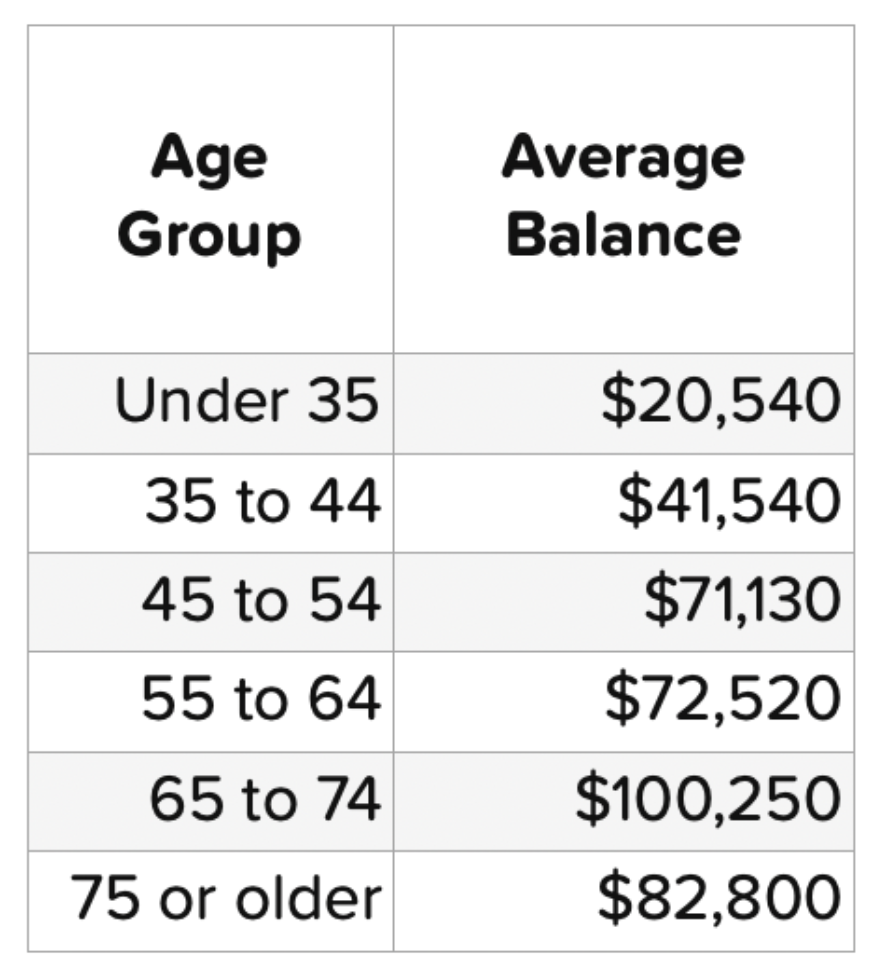
Older Americans tend to have more cash in the bank than younger Americans. The average person between the ages of 45 to 54 has $50,590 more than the average person under age 35. However, average savings account balances start to decline after age 70.
Here's how the average savings balances break down by age group, according to Federal Reserve data:
Average savings balance by household size
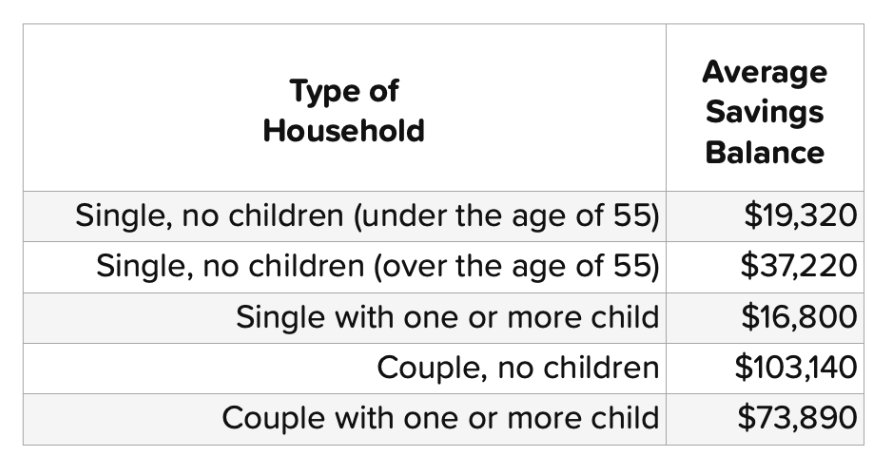
Kids and marriages tend to dramatically change a family's household savings balance.
On average, single-parent households under the age of 55 tend to have the lowest average savings balances, while couples without children tend to have the highest average savings balances.
Average Savings Balance by Race
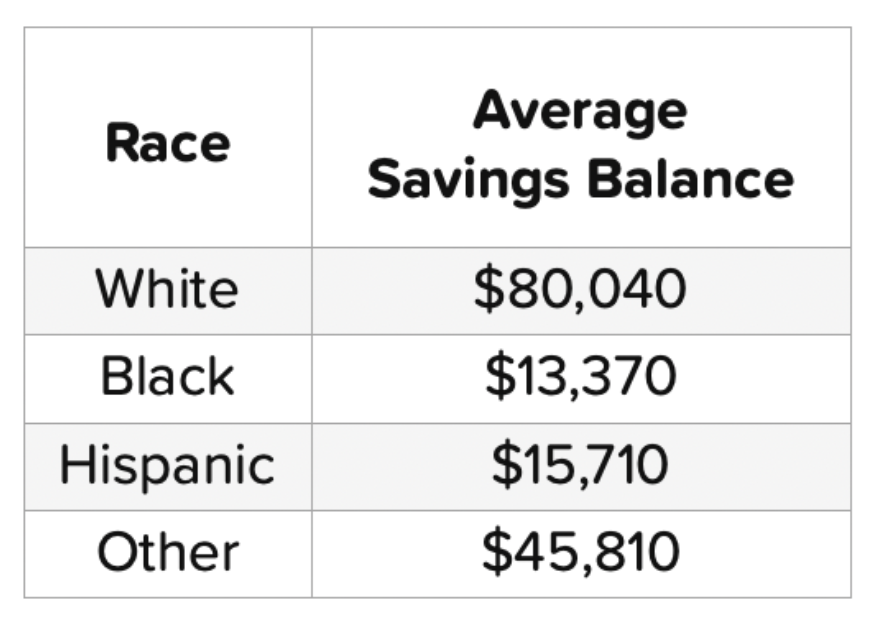
A large racial wealth gap still exists in America, from income to household wealth. According to data from the Federal Reserve, that gap flows into savings balances as well.
Average Savings Balance by Education Level
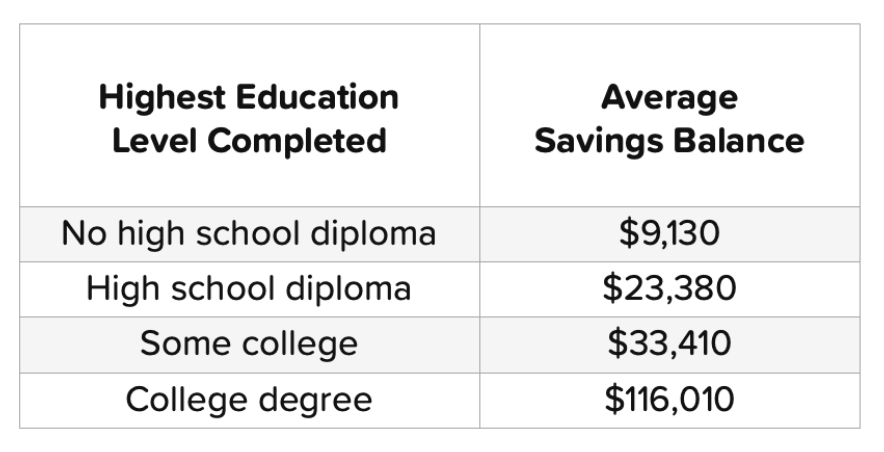
As a family's education level increases, so does the average savings balance. People who earned a high school diploma have an average savings balance double that of those who haven't. Similarly, people with a college degree have an average savings balance about five times greater than that of someone who only completed high school.
Here's how education affects savings balance, according to the 2022 Survey of Consumer Finances:
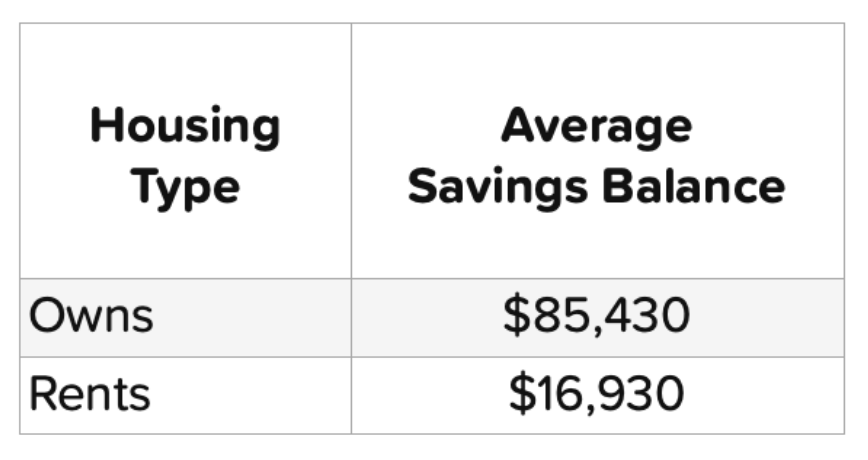
Average Savings Balance by Homeownership
People who own homes tend to save more, on average, than people who own homes have more cash in the bank than those who rent, according to Federal Reserve data.
Average American Savings Balances
The average American savings balance can vary greatly depending on your circumstances. Numerous factors, such as age, household size, race, education level, and homeownership status can impact how much you've saved.
Also, keep in mind that the data we've included from the Federal Reserve's 2022 Survey of Consumer Finances doesn't not factor in retirement accounts, and represents an average savings balance of high-income and low-income American families.
While saving for retirement and other goals is important, so is saving for potential emergencies. Emergency savings prevent you from having to take out a loan or use a credit card to cover unexpected expenses.
Unfortunately, not all Americans are financially prepared for an emergency.
According to the Making Ends Meet Survey and Consumer Credit Panel from the Consumer Financial Protection Bureau (CFPB) conducted in 2022, 24% of Americans don’t have any money saved for emergencies. And while 37% reported having at least a month’s worth of income in emergency savings, 39% reported having less than this.
Setting money aside for emergencies can have a significant impact on overall financial well-being, and data suggests an upward trend in emergency preparedness in the U.S. A 2021 report by the Federal Reserve on the economic well-being of U.S. households found that adults who said they could cover a small emergency expense using cash increased to 68% in 2021, up from 50% in 2013.
Average Emergency Savings
How much you should save for emergencies depends on a number of factors, but many Americans are saving $5,000 or less. The Transamerica Institute found the median emergency savings to be $5,000 as of late 2021, with over a third (34%) of Americans reporting saving less.
A few thousand dollars could help in many situations, but it may not be enough if you’re faced with back-to-back emergencies—or one very costly one.
How Much Emergency Savings Should I Have?
As a general rule, experts suggest keeping at least three to six months’ worth of living expenses in an emergency fund. But the ideal amount of emergency savings for you depends on your expenses and financial situation, and certain risk factors may require you to save more. For example, if you have dependents, low job security or a fluctuating income, a larger emergency fund could be helpful.
If you can’t save three to six months’ worth of expenses right away, save what you can now and contribute more when you can afford to. Starting somewhere is better than not starting at all.
Retirement Savings Statistics
As of September 2022, the Investment Company Institute found that 401(k) plans hold a combined $6.3 trillion in assets in across 625,000 plans. This encompasses millions of participants and retirees.
According to further data, while around three-fourths of non-retired adults were found to have some retirement savings, 28% had none. Unfortunately, this percentage was up from 25% in 2021.
401(k) plans aren’t the only place Americans are stashing retirement savings. While 54% of non-retired adults have their retirement savings in defined contribution plans like 401(k) or 403(b) plans, 47% have retirement savings outside of formal retirement accounts.
And just because money is earmarked for retirement doesn’t mean it never gets spent on other things. An economic well-being survey of U.S. households conducted by the Federal Reserve in 2023 found that 8% of non-retired adults tapped their retirement savings to cover an emergency in 2022.
What Is the Average Retirement Savings?
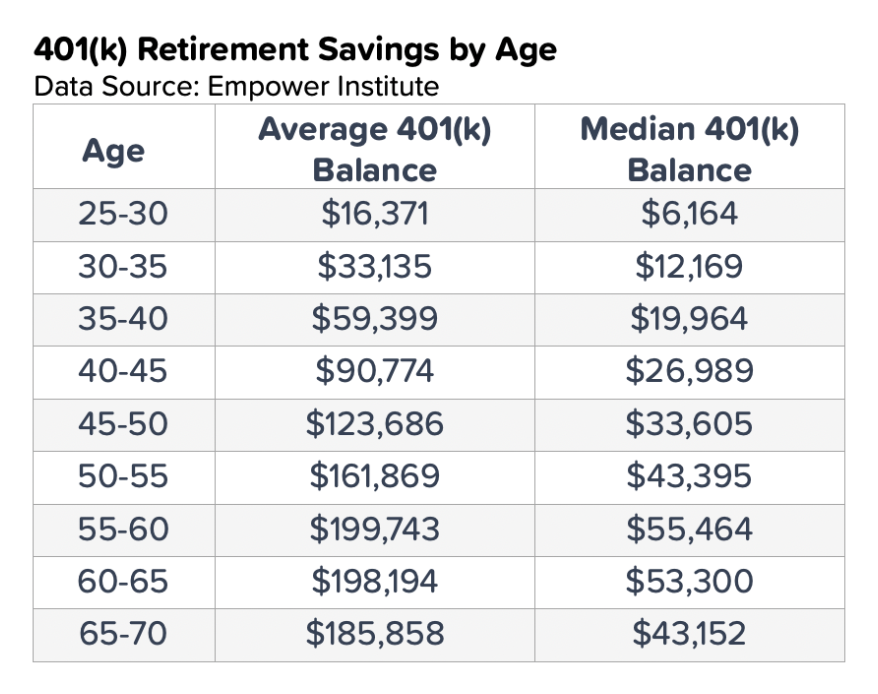
Average savings vary by age. This makes sense not only because savings ideally grow over time rather than shrink, but also because people usually earn less early in their careers than they will later on.
According to data from Empower (formerly the Empower Institute) in 2022, the average 401(k) account balance is $118,781 across all ages. However, the median account balance is much lower—only $32,689 across all ages. The average balance increases with each subsequent age group until the 60 to 65 age group, when many workers retire and begin to make withdrawals from their 401(k)s.
How Much Retirement Savings Should I Have?
The amount of money you need to save for retirement depends primarily on your life expectancy, the age at which you’ll retire and your spending habits.
An analysis by Fidelity Investments provides some general guidelines for defining this. These guidelines suggest you should have one times the amount of your salary saved by age 30, three times by age 40, six times by age 50, eight times by age 60 and 10 times your salary by age 67.
According to Fidelity, these figures assume you save at least 15% of your income annually starting at age 25, invest an average of 50% of your savings in stocks over your life and plan to retire at age 67 without inflating your lifestyle in retirement.
How To Maximize Retirement Savings
The average U.S. retirement savings balance in a 401(k) plan is $118,701, but the median is only $32,689. This means many individuals likely fall short of the targets laid out above. Especially for those not saving enough, it’s important to understand how to maximize retirement savings.
The sooner you start saving for retirement, the more likely you are to retire with enough—or more than enough—cash to cover your expenses. If you’re one of the 28% of non-retired Americans with no retirement savings, start saving today.
Aside from starting as early as you can, here are a few tips for maximizing your retirement savings:
- Contribute enough to your workplace retirement plan for employer matching. If your employer offers a match on retirement contributions, don’t let that free money slip away. Contribute at least as much as you need to receive the full match. For example, if your employer matches up to 5% of your salary, contribute at least 5%.
- Contribute to other tax-deferred accounts. In addition to using your workplace retirement plan, there are other accounts you can open to build retirement savings. Consider a traditional IRA, Roth IRA or health savings account (HSA) for tax-advantaged savings. If you’re maxed out on these accounts, you can always funnel extra savings into a taxable brokerage account.
- Make catch-up contributions if you’re over age 50. When you reach age 50, the IRS allows you to make extra contributions to your retirement accounts, including both 401(k) plans and IRAs, to help bolster your savings. If you started late or fell behind with your retirement savings, you can get back on track by making catch-up contributions up to the annual limits.
A January 2023 survey by Forbes Advisor on financial regrets and successes uncovered interesting data about U.S. consumer savings trends. It found that the most common financial habit Americans planned to adjust in 2023 was tracking spending/creating a budget (43%). Americans also indicated wanting to save more and spend less. The next three most popular responses participants gave were spending below their means (40%), paying down debt (37%) and adding to emergency funds (25%).
This survey also found that 56% of Americans who experienced financial regret in 2022 cited not saving more money as one of their top three misgivings. Meanwhile, 57% of Americans who experienced financial success named increasing their savings as one of their top three triumphs.
Forbes Advisor also conducted a survey in March 2023 to analyze how often Americans save and what methods they use. When it comes to putting the habit of saving into practice, 44% of Americans use recurring transfers to save automatically, 38% allocate a portion of their pay directly into a savings account and 35% manually transfer their funds. Some use a combination of methods to save.
Current Savings Account Rates
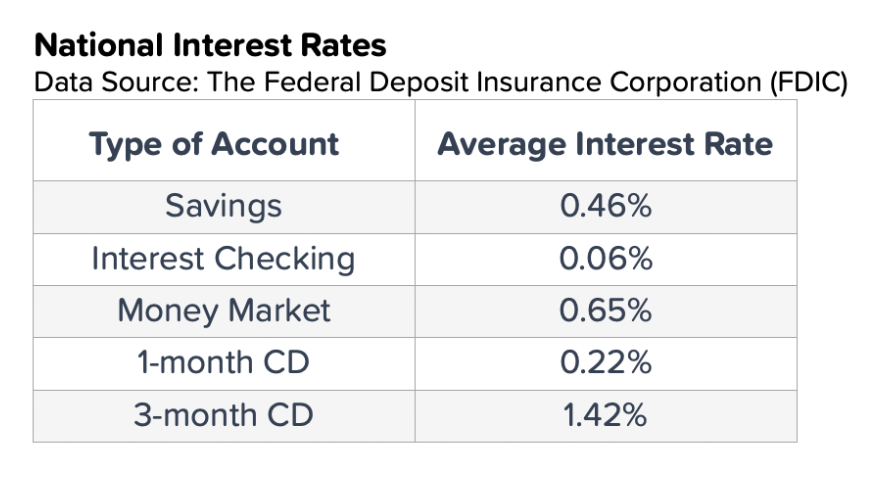
Research suggests that interest rate hikes encourage Americans to save. But even though savings account interest rates have been on the rise, they still vary widely from bank to bank. Below is a look at national interest rates as of November, 2023.
The average savings account rate is a benchmark for the overall interest-rate environment, but it’s not a rate you should settle for.
Rather, aim for an annual percentage yield (APY) many times the national average, such as those offered by high-yield savings accounts. It’s easy to find a high-yield savings account that offers a competitive return with a no or low minimum balance requirement.
National Interest Rates
Data Source: The Federal Deposit Insurance Corporation (FDIC)
Start Saving Money
With a dramatic drop in Americans’ personal savings rates over the past couple of years as well as clear indications that many want to save more, there’s no doubt that saving is easier said than done.
Saving is important for achieving financial freedom and confidence. This requires little convincing, but it can be difficult to know where to start. Use these tips to cut down costs and boost your savings:
- Pay off high-interest debt first. The less money you need to throw at your debt, the more you can funnel toward your savings goals. Start by paying off your high-interest debt first, including credit card debt and loans, because it is often the costliest. Try to make more than the minimum payments and focus on the debt that costs you the most first.
- Track your spending and create a budget. If you’re not already using a budget, try it now. Start by tracking your spending to see where your money goes each month. Based on this information and your savings goals, create a budget that includes all of your income and expenses. Look for areas where you can redirect spending toward savings and debt payoff.
- Automate savings wherever possible. If you want to save without needing to think about it, automation is key. Automate monthly or weekly transfers from checking to savings and set up automatic contributions into your workplace retirement account. Start with however much you can afford, even if it’s not a lot. Increase contributions as your paycheck and budget allow.
- Plan for large expenses. When you allow large expenses to sneak up on you, they can derail your budget, empty your savings or force you to take on high-interest debt. Instead, do a little planning for significant spending. List large and irregular expenses like car registration costs and vacations and break them down into monthly savings goals. Include these in your budget.
- Take advantage of high-yield savings accounts. When you’re working hard to save money, a competitive interest rate can accelerate the process. To get the most from your savings, put your cash in a high-yield savings account instead of a traditional savings account. High-yield savings account rates beat national averages and tend to offer more flexibility and tools.
Bottom Line
In recent years, particularly throughout 2021 and 2022, there has been a noticeable uptick in the average balances of American savings accounts, a trend that seemed to signal a positive shift in savings behavior. However, this increase in savings account balances doesn't fully capture the broader picture of American financial habits. Despite these initial gains, the overall proportion of income that Americans are saving has diminished, with many individuals finding themselves underprepared for emergency situations.
At the same time, the financial landscape is evolving. Interest rates have climbed to their highest levels in 15 years, offering consumers a more favorable environment for saving money efficiently. This shift presents a valuable opportunity for those aiming to bolster their savings and emergency funds, aligning with the aspirations of many to improve their financial resilience.
However, the journey to effective saving is fraught with challenges and can be influenced by many factors. Key among these are age, geographic location, income levels, and spending habits, all of which play a crucial role in determining your ability to set aside funds for unforeseen expenses, retirement, and other financial objectives.
Despite these challenges, there are strategies and tools available that can greatly assist in the pursuit of financial security. Leveraging tax-advantaged accounts, investing in high-yield savings options, and implementing automatic transfers are just a few of the methods that can facilitate more effective saving. When these tools are utilized, especially from an early age, they can significantly enhance one's ability to meet both short-term needs and long-term financial aspirations.
While the path to saving is complex and varied, understanding the current economic context, recognizing the individual factors that impact saving capabilities, and employing strategic financial tools can collectively empower individuals to make substantial strides towards achieving their financial goals.
The Knowledge Gap

Knowledge separates those who take advantage from those who are taken advantage of.
Why? Because knowledge translates to action.
This is especially true when it comes to money.
Think about it. The Sucker “knows” just a few things about money…
“I need money to buy things.”
“I work to earn money.”
“I will never earn much money.”
Now, consider what the Wealthy know about money…
“I can use money to start a business.”
“I can use money to earn compound interest.”
“I can use money to make my family’s life easier.”
“I can use money to leave my loved ones a legacy.”
The difference is simple.
Because the Sucker knows little about money, they see it only as a necessary evil.
But the Wealthy know money creates opportunity.
It all starts with knowledge. If the Sucker knew how money actually works, they would see it—and manage it—differently.
What do you think you know about money? If you’re not sure, scroll up to the top of my site and head over to the Learn section. There, you’ll find the Change Your Literacy Change Your Life Challenge, a quick quiz that will reveal how much you actually know about money.
When you’ve completed the quiz, let me know how you did. Better yet, what answers surprised you? It may be that you’ve never been taught things like the Power of Compound Interest or Risk Diversification. And that can warp your ability to see money as an opportunity instead of a limitation.
It all starts with your thinking. It all starts with learning how money works.
Exposing the Roots of Your Financial Insecurity

If you feel like your finances are teetering on the edge of disaster, there’s a likely culprit—financial illiteracy.
Do you agree or disagree with these statements?
The statements are adapted from research designed to test relationship security. They aren’t dependent on your income or savings level. Instead, they measure something far more relevant—how you feel about your finances.
And if you’re like many, you agree with most, if not all of those statements. It’s an indication that you feel financially insecure. And there’s a reason for that…
It’s because your finances are in grave danger.
It’s not your fault—nobody taught you how to create financial security. In fact, you may not have learned the basic building blocks of growing wealth, much less how to protect against losses, inflation, or tragedy.
So is it any surprise that your finances feel like a house of cards? And since you’re an intelligent, normal human, you can feel the looming threat of collapse. It weighs on you, makes you anxious.
And it should—your feelings are a blaring alarm announcing that your situation is precarious, and you need to act.
But you can’t respond to danger until you identify what’s wrong. And the greatest enemy of your financial security? Financial illiteracy.
Think about it—would your finances have reached this point if you knew how money worked? Of course not!
If you knew how to actually build wealth and avoid financial blunders, you likely would have chosen a completely different path.
So the antidote to your feelings of financial insecurity is simple—learn how money works. Then, apply your knowledge. You may be surprised by the new sense of security that appears in your life.
Knowledge is Not Power

Your financial education must include both knowledge AND what steps to take. It must teach you wealth building concepts AND wealth building strategies.
If you’re lacking knowledge, it’s impossible to start your journey to financial independence because the money decisions you make without it are likely to do more harm than good.
But knowledge alone is not enough. Knowledge without guidance leads to information overload and analysis paralysis.
It’s what all financial professionals hear: ”You’ve taught me about the Power of Compound Interest. Great! And now I know about the Time Value of Money. Wonderful! But where the heck do I find an account with the interest rate I need to reach my financial goals?”
Tony Robbins said it best. “Knowledge is NOT power. Knowledge is only POTENTIAL power. Action is power.”
So before you create a strategy to start building wealth, learn how money works. Discover the financial illiteracy crisis and its impact on your peace of mind. Learn about the Power of Compound Interest and the Time Value of Money and how those concepts can make your money earn more money. Realize the wealth building potential of starting a business.
Then, get with a licensed and qualified financial professional. Start working through The 7 Money Milestones. They’re time-proven steps that can move you from financial hardship to financial independence. The Milestones are…
• Financial Education
• Proper Protection
• Emergency Fund
• Debt Management
• Cash Flow
• Build Wealth
• Protect Wealth
Why these steps? Because they apply what you’ve learned to simple strategies, like…
• Securing proper financial protection for your family
• Leveraging a side hustle to boost cash flow
• Protecting your wealth with an estate plan
The Milestones take your newfound knowledge and transform it into action. They move you from having the potential to be wealthy to walking the path towards securing your future.
In short, they help unlock your power to create the future you want.
Learn how money works. Follow the Milestones. Take control of your financial future. With this education, you can be on the road to wealth in no time flat.
Is Your Cash Flowing?

How much cash do you have left at the end of the month after you’ve covered the essentials AND treated yourself? (I’m guessing not much.)
Wish your paycheck went a little further? You’re not alone—not by a long shot. Most Americans are living paycheck-to-paycheck and saving little to nothing. So how do you increase your cash flow so you can stop living in the Sucker Cycle and start saving and investing more?
In the book, HowMoneyWorks: Stop Being a Sucker, we attack this challenge head on in Milestone 5 of the 7 Money Milestones.
Here are a few tips to get your cash flowing towards your future…
Redirect your cash flow
There are a million little things that siphon away your paycheck. Credit card debt, monthly subscriptions, and your fast food habit all chip away at your income. This “death by a thousand cuts” is a foolish spending cycle that prevents you—and countless other suckers—from creating an emergency fund, protecting your income, and building wealth for the future.
That’s why it’s so important to make and maintain a budget. It’s like a map of where your cash is going. Once you have that knowledge, you can figure out where you need to dial down your spending and start redirecting your cash. Don’t get too detailed. You don’t need to get overwhelmed by spreadsheets. Try creating a one-page list of expenses, freeing up as much cash as possible. Take your budget to your financial professional and discuss how best to use this available cash.
Open up new income streams
Budgeting and cutting back on spending might not be enough. Life throws plenty of unexpected (and expensive) problems at us that might not have a budgeting solution. You may need to look for new income streams to maintain the lifestyle you want while also saving for the future.
You’d be surprised by how many possibilities there are to create additional income streams—many of which offer the chance to make money from home. Maybe now is the time to discover that your favorite hobby or area of interest is actually a way to earn some cash. That could look like a side hustle or weekend gig, but you might find that your skills and ideas are full-time business opportunities just waiting to happen! Research which of your ideas and skills are in demand, figure out how much time and effort it will take to get started, and decide how much time you’re willing to commit. (It could be easier than you think!)
Increasing your cash flow can open up a whole new world of opportunities. That extra money you have from cutting back on takeout and streaming services could be how you fuel the power of compound interest and finally start saving for retirement. That several hundred dollars you bring in from teaching guitar lessons each month could be how you pay off your credit cards and free up even more cash. There’s no doubt your options can really open up once your cash starts flowing!
Lessons from Las Vegas

Why are so many people so bad with money, even though they know it’s important?
There’s an article from Psychology Today titled “The Psychology of Money.” It was published in 1995, but the central question still rings true—why do people sacrifice so much for money, only to blow it all?
Michael Ventura, the author, asks the question in the context of Las Vegas, where hard earned money goes to die. He paints a vivid picture of brightly lit casinos packed with overweight middle-aged men in casual clothes hunched over blackjack tables and slot machines.
Not one of them looks happy.
They likely don’t talk much with their spouses.
They spend a few minutes each week in conversation with their kids.
All they do is work. Their income and financial resources define their social status.
And yet here they are, gambling it all away and hating every second of it.
And again, it begs the question of WHY? Why the insane urge to unravel everything they’ve worked so hard to create?
Here’s a thought—what they’re doing at the casino isn’t too far off from what the sucker does every day. They throw away money in hopes of a rush, and wait to see how the cards fall.
Think about it—they work and work and work for money, but for what? So they can buy a house, a car, and maybe take a nice vacation. Maybe they think it will make them happy. But what does that really get them? A bigger mortgage, higher monthly payments, and the constant worry about losing their job and being unable to make ends meet. They don’t know how to use their money to build wealth or a stable, happier life. How could they?
They’ve never been taught.
The casinos of Vegas call their patrons suckers. Banks give you a sucker on the way out the door. They both leverage the same Sucker Cycle, the same psychology.
So what’s the lesson from Las Vegas? That everyone’s a sucker? That you’ll never be good with money?
No.
The lesson is that you must learn how money works. You must realize that something better is possible with your money. With your life. That you actually have what it takes to make decisions. To write a story with a better ending than hunching over a slot machine with a blank expression on your face.
Home Price vs. Interest Rate: Which Is More Important?

Millennials, this one’s for you—a low interest rate DOES NOT balance out a high home price.
Millennials face a dilemma—pay greater home prices now but at lower interest, or hope that interest rates increase in the future which historically has lowered home prices.
Some Millennials are choosing to face the housing market head on, while others are waiting things out.
So which camp is “right”? And, if you’re a Millennial, which camp should you join?
The answer: None of the above. The real question is—and has always been—can you actually afford to own a home?
Let’s do the math…
Suppose you live in a fantasy where the housing market is semi-normal somewhere in the world. You have two potential homes in the running—one in the suburbs, the other in the city.
The suburban home costs $300,000 with a 30-year mortgage at a rate of 6%.
The city home costs $500,000 with a 30-year mortgage at a rate of 2%.
One Sucker sees a lower interest rate and ignores the price tag, while another Sucker sees the lower price tag and ignores the higher interest rate. Both think they’re getting an historic deal.
But get this—the monthly payment will be almost identical for either house.
The wealthy realize that high prices and high interest rates have the same result—you pay more for your home, and the bank profits.
Instead, the wealthy ask themselves questions like…
Can I afford my monthly payment?
Have I saved enough for an adequate down payment?
Will I have enough left for furniture and repairs?
Have I factored in the cost of property taxes and HOA fees?
The takeaway? The wealthy don’t lose sight of what matters most—their cash flow. Just because interest rates are lower doesn’t mean you’ll be able to make the monthly payments.
Do your homework.
Use a mortgage calculator.
Research your potential new neighborhood for any HOA fees or other costs you might incur.
Figure out how much you can afford to spend on monthly payments as a part of your overall budget.
Meet with your licensed and qualified financial professional to talk about your overall financial picture and how your new home will fit in with your current situation and your retirement strategy.
It’ll save you heartache—and maybe some money—in the long run.
How Consumers Prefer to Cover Long-Term Care Costs

It’s a fact – consumers prefer long-term care riders to stand-alone long-term care (LTC) insurance.
In 2018, 350,000 Americans bought long-term care insurance.¹
84% chose linked-benefit coverage.
In other words, their LTC insurance was a rider on a life insurance policy or another financial vehicle.
Only 16% chose stand-alone LTC insurance.
If you had to guess why riders won out, what would you say?
- Because LTC riders are often far more affordable than stand-alone insurance?²
- Because LTC riders aren’t subject to steadily increasing premiums?³
- Because stand-alone LTC insurance is growing harder and harder to qualify for?⁴
If you guessed any of the above, you’d be right! They’ve all contributed to the rising popularity of LTC riders.
For many, LTC riders are a no-brainer. If something’s more affordable, easier to qualify for, and less subject to change, wouldn’t you prefer it, too? And considering that 70% of people age 65 and older will need LTC, it’s a form of financial protection everyone should explore.⁵
That’s not to say an LTC rider is the perfect solution for your situation. If you don’t need permanent life insurance, then a stand-alone policy may be the way to go.
That’s why it’s critical to meet with a licensed and qualified financial professional—they can evaluate your situation and what tools and strategies best meet your needs.
Start Building Wealth in a Minute or Less

Automation is the simplest—and perhaps the most powerful—move you can make towards retiring wealthy.
Imagine if you could automate going to the gym. You download an app, tap a few buttons, and then… do nothing. Over the next few weeks, you notice changes. Your legs get firmer. Your biceps bulk up. You walk past mirrors and think “darn, I look GOOD!” Friends ask if you’ve been going to the gym. You smile, because you know the truth—you haven’t been once.
It sounds too good to be true. But when it comes to building wealth, “bulking up” can become a reality.
That’s right—you can automate building wealth. And it only takes a few moments.
Simply Google search how to automate deposits in your wealth building accounts, and follow the steps. It should take you less than a minute once you know how it’s done.
And just like that, you’ve started building wealth. Your money will effortlessly flow from your bank account into your wealth building accounts. It’s that easy.
Here are a few prerequisites before you start automating…
Decide which accounts are best for your situation
This isn’t something to do alone. Meet with your licensed and qualified financial professional, and review your situation and your goals. They’ll be able to recommend accounts and wealth-building vehicles.
Review your budget
What’s the most you can automate towards building wealth without derailing your lifestyle? See how much money you have leftover each month. If the answer is zero, slash your spending and automate whatever you free up.
Know when you get paid
The best time to transfer money from your bank to wealth building is right after payday. Review your pay schedule, then automate transfers to go through a day or two after.
Wealth doesn’t appear overnight. It can take years. But there are simple steps you can start this afternoon to make the process that much easier. It just takes a little knowledge and a few seconds. So get started today!
What Millennials Need to Retire Wealthy

It’s official—Millennials are serious about building wealth.
According to a recent study, Millennials (ages 25 to 40) have an average of $51,300 in personal savings, while their retirement accounts have an average balance of $63,300.¹
That’s far higher than it was just a few years ago. In 2019, they had saved just $23,000 for retirement.² They’ve nearly tripled their wealth in less than 3 years!
It’s no surprise. Few generations have gotten kicked in the pants quite like Millennials. Between recessions, pandemics, frenzied housing markets, and international instability, they’ve learned that wealth isn’t a luxury—it’s an absolute necessity.
But Millennials still have a long way to go before they retire wealthy. Here’s what they need if they’re going to arrive at their long-awaited destination…
Millennials must know—and use—the Rule of 72.
The Rule of 72 is a simple mental math shortcut that estimates when your money will double, given a fixed compounding interest rate. Here’s what it looks like…
72 ÷ interest rate = years to double
It’s simple, it’s powerful, and it might change the course of your financial future.
Let’s say you’re 35 years old with $60,000. That’s a solid start. But how can you turn $60,000 into $1 million by age 67?
Think of it like this—you need to double your money just over 4 times to reach $1 million.
Now, subtract your current age from your retirement age. That’s how long you have left to build wealth.
67 - 35 = 32 years
So you have 32 years to double your money just over 4 times. In other words, your money needs to double every 8 years.
Now it’s time to use the Rule of 72, but with a slight twist—swap the interest rate with the years for each double.
72 ÷ years for each double = interest rate needed
Plug in your numbers, and you get…
72 ÷ 8 years = 9% interest rate
In this scenario, you’d need just over a 9% interest rate to retire as a millionaire.
Armed with that knowledge, you’ll be better able to see through gimmicks like a “high-interest savings account” that offers .06% interest. You’ll also be left with just one question—where can you find an account with 9% interest?
Answer that question with your financial professional, and you’re on the right track for retiring wealthy.
Try the exercise above with your age and personal savings. What was the result? Then, contact a financial educator who can help you fine-tune a strategy to reach your retirement goals.
Can You Budget Your Way to Wealth?

Budgeting is good, budgeting is great. But if you’re building wealth, it will only get you part of the way.
Budgeting is usually the first move for anyone getting their finances in order. It’s basically just tracking your expenses against your income, and then slashing spending.
Consider that 64% of Americans live paycheck-to-paycheck.¹ Low income isn’t to blame—48% of families earning over $100,000 also live paycheck-to-paycheck!² So for many, budgeting is an absolute necessity.
But will budgeting alone put you on the fast-track to wealth? Probably not.
Let’s say you earn $45,000 per year (after taxes), but you spend $45,000 every year. Congratulations! You’re living paycheck-to-paycheck. When you decide to get serious about building wealth, you’ll face a stark reality—you have no money left over to save!
So you start budgeting. You move from your apartment in midtown to a hovel in the suburbs. You stop going out. You cook at home. You walk to work. You swap lightbulbs for candles. You scrap Netflix, Spotify, and cable—and you start whittling random sticks you find in the yard to pass the time.
By the end of the year, you’ve spent only $30,000. Good for you! You have $15,000 to devote towards building wealth.
But what if you’re still short of your savings goals? You’ve cut spending to the core. Unless you’re willing to scavenge for food and live in a tent, cutting your spending further is going to be tough.
You only have one option—boost your income.
What does that look like? It could look like scoring a promotion. Or getting a new job. It could also look like starting a side hustle or becoming a part-time entrepreneur. You actually may be surprised at how many of your talents and hobbies have income-boosting potential!
That’s why for the 7 Money Milestones in the book How Money Works: Stop Being a Sucker, budgeting and boosting income are rolled together into a single Milestone—Milestone 5: Increase Cash Flow. Budgeting will get you started, but to truly supercharge your savings, you’ll need to increase your income stream, or create a multiple income streams.
Think about it like this—Jeff Bezos drove a Honda Accord for decades, but that’s not what made him a billionaire. Rather, he began with frugality and then built an income-generating empire.
So if you’re just beginning to build wealth, start with budgeting. Clean up your spending as much as possible before boosting your paycheck.
If you’re already frugal, good for you! You’ve made a great stride towards building wealth. Now, it’s time to consider boosting your income further.