 Request a copy of our book(s)
The Paycheck Nobody Sees

What happens to a family's finances when the person who does not earn an income is gone.
There is a conversation that tends to end early.
A couple sits down to talk about protecting the family. One of them earns the income. The other runs the household: the children, the schedules, the meals, the appointments, the driving, the laundry, the hundred small decisions that keep a home functioning.
They talk carefully about protecting the income earner.
Then someone says, "But you don't need coverage. You don't earn anything."
The conversation stops there, and a significant financial exposure walks out of the room with it.
The Assumption Underneath
The assumption is that life insurance replaces income, so a person without income has nothing to replace.
The first half is true. The second half is not.
Life insurance is not really about replacing a paycheck. It is about replacing financial value that a household depends on. Sometimes that value arrives as wages. Sometimes it arrives as work that a family would otherwise have to pay someone else to do.
When the second kind of contribution disappears, the household's expenses do not stay the same. They go up.
What Would Have to Be Purchased
Set aside the abstract question of what someone's work is worth, and ask a concrete one instead.
If that person were gone tomorrow, what would the surviving parent have to buy?
For a family with young children, the list is not short. Full time childcare or daycare. After school care. Summer coverage during school breaks. Transportation to school, practices, and appointments. More prepared food and fewer home cooked meals during a period when nobody has the capacity to cook. Housekeeping. Yard work. Someone to manage the logistics that used to be managed for free.
There may also be care flowing in the other direction. Many households depend on one person to look after an aging parent, coordinate medical appointments, manage medications, or provide daily support. That care has a replacement cost too, and it is often higher than childcare.
None of this is hypothetical. These are line items with prices in your zip code.
The Second Financial Hit
There is a further cost that families rarely anticipate.
The surviving earner's career often changes.
Someone now has to handle school pickup, sick days, and school holidays. Travel becomes harder. Overtime becomes harder. A promotion that requires relocation or longer hours may no longer be possible. Some people reduce hours. Some change roles. Some leave a job entirely for a period of time.
So the household absorbs two blows at once: new expenses it did not have, and often reduced earning capacity from the person who is still working.
That combination is what turns a loss into a financial crisis, and it is precisely the outcome protection is meant to prevent.
About Those Big Numbers
You have probably seen headlines putting a salary on a stay at home parent's work.
They vary enormously, and the reason is methodology.
Insure.com's 2025 Mother's Day Index put the figure at 145,235 dollars a year. It is built by taking roughly nineteen occupational wage categories, cook, driver, caregiver, housekeeper, and others, and applying professional market wages to the hours a mother typically spends on each. It is a promotional index rather than an economic study, and because it stacks specialist wages role by role, it describes a workload no single person could actually be hired to perform.
Salary.com, which approaches it as one job title rather than a bundle of professions, listed the average stay at home mom equivalent at about 46,374 dollars a year as of August 2026.
Both are defensible. They are answering different questions. One asks what it would cost to hire a specialist for every function. The other asks what a single generalist position would pay.
The gap between them is a useful reminder: do not build your family's protection on a headline.
Build it on the prices where you live.
Estimating Your Own Number
This is more manageable than it sounds, and it takes an evening.
- Look up full time childcare in your area for each child who would need it, and multiply by the number of years until they would not.
- Add after school and summer care for school age children.
- Price housekeeping at whatever frequency your household would realistically use.
- Estimate the increase in food costs if fewer meals were made at home.
- If your household relies on that person for elder care, price the equivalent home care or facility support.
- Estimate the effect on the surviving earner's income: reduced hours, declined promotions, or time away from work.
Add it up. Then ask how many years those costs would continue.
That total, over that duration, is a far better basis for a coverage decision than any national average.
It Is Not Only Stay at Home Parents
The same blind spot appears in several other households.
A grandparent who provides regular childcare so the parents can both work. If that support ends, the family may face daycare costs it has never budgeted for.
An adult child who is the primary caregiver for a parent. Their absence may mean paid care, or a sibling leaving a job.
A part time earner whose contribution is dismissed as "not the real income," even though it covers the mortgage or the health insurance.
A business partner or family member who handles operations without drawing a market salary.
In each case, someone is providing value the household depends on and no paycheck records.
Coverage Still Has to Be Justified
An honest note belongs here.
Insurers do not simply issue any amount of coverage on any person. Life insurance requires insurable interest and financial justification, and underwriting for a non earning spouse or caregiver typically considers the household's overall circumstances, including the working spouse's coverage. Available amounts, underwriting rules, and requirements vary by insurer and state.
That is not a reason to skip the conversation. It is a reason to have it with someone licensed who can explain what is actually available in your situation and how it is evaluated.
Start With the Right Question
The question was never "who earns the money?"
The question is "what does this household depend on, and what would it cost to replace?"
Ask it about every adult in the home. Include the work that never appears on a tax return. Price it locally. Then talk with a licensed professional about what protection makes sense for your family, in what amount, and for how long.
At TheMoneyBooks, financial education is about seeing your money clearly, including the parts of it that never show up as money.
Some of the most valuable work in your household has never been paid. That does not make it free to replace.
This article is for educational purposes only and does not provide individualized insurance, financial, tax, or legal advice. Coverage availability, amounts, underwriting requirements, and eligibility for a non earning spouse or caregiver vary by insurer, product, and state. Cost estimates referenced here are illustrative survey figures, not quotes or guarantees. Consult an appropriately licensed professional about your circumstances.
The Price You Think You'd Pay

Most Americans overestimate what life insurance costs. That guess carries a cost of its own.
Ask someone who does not own life insurance why they have not bought any, and you will usually hear a version of the same answer.
"It's too expensive."
It is an honest answer. Household budgets are real, and nobody wants to commit to a monthly payment they cannot sustain. Declining something you cannot afford is a reasonable financial decision.
But there is a problem hiding inside that answer.
Most people have never actually priced it. They are not declining a number they were quoted. They are declining a number they imagined.
And the research suggests the imagined number is usually wrong.
The Size of the Gap
Each year, LIMRA and Life Happens conduct the Insurance Barometer Study, a survey of American adults about how they think and feel about life insurance. One of its questions asks people to estimate what a basic term life policy would cost them.
Most get it wrong, and they get it wrong in the same direction.
Life Happens summarized the 2025 findings plainly: about three quarters of adults overestimate the true cost of life insurance.
The 2026 study puts a finer point on it. Among consumers under thirty, only 4 percent correctly estimated what a basic term policy would cost them each year.
The size of the miss is what makes it remarkable. When LIMRA asked adults age thirty and younger to price a 250,000 dollar, twenty year level term policy for themselves, their median guess came in roughly ten to twelve times higher than the actual cost.
Not ten percent higher. Ten times.
Meanwhile, expense remains one of the most common reasons people give for not owning coverage. A large number of households are turning down protection based on a price they never checked.
Why the Guess Is So Far Off
There is no mystery here, and there is nothing foolish about being wrong.
Most people have never seen a life insurance quote. They have no reference point, so their brain reaches for the nearest comparison, which is usually another insurance bill. Car insurance. Health insurance. Homeowners coverage. Those numbers are larger and more familiar, so the estimate drifts upward.
There is also genuine confusion between kinds of coverage. Permanent life insurance and term life insurance serve different purposes, are structured differently, and are priced very differently. Someone who has only ever heard about a permanent policy may be applying that price to every policy.
And there is timing. The people most likely to overestimate are often young and healthy, which is precisely when term coverage tends to cost the least.
The guess is understandable. It is also expensive, because it can delay a decision during the years when the same protection is generally most affordable.
What Actually Determines the Price
Premiums are not arbitrary. A handful of factors do most of the work.
Your age. This is the one variable that only moves in one direction. Waiting does not improve it.
Your health. Insurers evaluate applicants through underwriting, which may consider medical history, current conditions, height and weight, family history, prescriptions, and in some cases lab results. Better health classifications generally mean lower premiums.
Tobacco or nicotine use. This typically has a significant effect on pricing.
The amount of coverage. More death benefit costs more. This is the most direct lever you control.
The length of the term. A thirty year term generally costs more than a twenty year term for the same face amount, because the insurer is covering a longer period.
The type of policy. Term coverage for a defined period is structured differently from permanent coverage designed to last a lifetime, and the pricing reflects that.
Riders and features. Optional provisions may add cost, though some are included.
Depending on the insurer and the product, other factors such as occupation, hobbies, or driving record may also be considered. Underwriting rules vary, which is one reason two companies can quote the same person differently.
The Cost of Waiting Is Not Theoretical
Here is the part that is easy to miss.
Age is not the only thing that changes while you wait. Health changes too.
A condition that develops between now and the day you finally apply may affect your classification, your premium, or in some cases your eligibility. Nobody plans on that, which is exactly the point.
The lowest premium you will ever qualify for is generally available to the healthiest version of you, and that version is usually the current one.
This is not a reason to rush a decision you do not understand. It is a reason not to postpone a conversation indefinitely because of a number you assumed.
Cheap and Right Are Not the Same Word
None of this means the goal is simply to find the lowest price.
Two policies with the same death benefit are not automatically equivalent. Term length, underwriting classification, renewal provisions, conversion options, riders, and the insurer's financial strength all matter. A quote that looks lower may assume a health class you have not qualified for yet, or a term that ends sooner than your need does.
Price deserves attention when the coverage is genuinely comparable. Comparing requires understanding what you are comparing.
The useful version of this conversation is not "what is the cheapest policy." It is "what is the appropriate amount and duration of coverage, and what does that actually cost from more than one carrier."
Fit It to a Budget You Can Keep
There is one more reason the real number matters.
Protection only works if it stays in force. A policy that strains a household budget is a policy at risk of lapsing, often at the worst possible moment.
So the honest question is not only what coverage costs, but what your household can sustain over the full period the coverage is meant to last. Sometimes that means a smaller death benefit maintained reliably rather than a larger one abandoned in year three. Sometimes it means a different term length. Sometimes it means starting with what fits now and revisiting later.
That is a real conversation, and it can only happen once you replace the imagined price with a real one.
Find Out Your Actual Number
You do not have to buy anything to learn what coverage would cost you.
Decide roughly how much protection your household would need and for how long. Then get real quotes based on your age and health rather than a guess based on someone else's.
ShopYourTerm.com is one resource for exploring term life insurance options and comparing costs. A licensed professional can help you interpret what those quotes assume, what happens when a term ends, and which features matter for your circumstances.
Then make a decision based on information.
You may find the coverage costs more than you hoped. You may find it costs far less. Either way, you will be deciding with a number instead of a feeling.
Most families never turn down life insurance. They turn down a price they invented, and never checked.
How Much Life Insurance Do You Actually Need?

The right number comes from your responsibilities, not from a rule of thumb.
Most families ask two questions about life insurance, and they usually ask them in that order.
The first is about the product. Term or permanent? Which company? What does it cost?
The second, which really belongs first, is much simpler. How much?
It is the question people skip, guess at, or hand off to whoever is quoting the policy. And it may be the single most important number in the entire conversation, because every other decision depends on it.
At TheMoneyBooks, we believe financial education should help you arrive at your own number and understand how you got there. Not because you need to become an expert, but because you should be able to explain the reasoning behind the protection your family depends on.
Why Rules of Thumb Are a Starting Point, Not an Answer
You have probably heard some version of the standard advice. Buy ten times your income. Or twelve. Or seven, depending on who is talking.
Multiples like these exist because they are easy to remember and they are usually better than no estimate at all. They give a rough sense of scale.
But a rule of thumb does not know your mortgage balance. It does not know that you have three children under ten, or none at all. It does not know that your spouse earns more than you do, or that your parents live with you, or that you own a business with a partner who has no plan if you are gone.
Two people can earn identical incomes and have completely different protection needs.
A multiple of income is a hypothesis. Your actual obligations are the evidence.
Start With What Would Still Have to Be Paid
One practical way to think about the number is to list what would not disappear if your income did.
A common framework organizes it into four categories.
Debt. Credit cards, car loans, personal loans, and any co-signed obligations. Would your family need to clear these, or would the payments continue out of a smaller household budget?
Income. The portion of your earnings your household actually depends on, multiplied by the number of years they would need it. A family with young children may be looking at fifteen or twenty years. A household two years from retirement may be looking at a much shorter window.
Mortgage. The remaining balance, or at least enough to keep the payments manageable. Housing is usually the largest fixed cost a family carries, and it is often the one they least want to change while grieving.
Education. What you hope to provide, whether that is a state university, a trade program, or something else. Be honest about what you intend to fund rather than what you wish you could.
Add those together. Then subtract what already exists: current coverage, savings, and other resources genuinely available for this purpose.
What remains is a working estimate of the gap.
Do Not Forget the Value That Never Shows Up on a Pay Stub
Income replacement is the part most people understand. The part they routinely miss is the work that never generated a paycheck.
If a household relies on one person for childcare, meal preparation, transportation, elder care, and household management, those responsibilities do not end when that person does. They get outsourced, absorbed by the surviving parent, or both.
That has a real cost, and it belongs in the calculation.
Count What You Already Have, Carefully
Before deciding how much new coverage you might need, take an accurate inventory of what you own.
Look at any individual policies you purchased. Confirm the death benefit, the type of coverage, how long it lasts, and what it requires you to keep paying.
Then look at workplace coverage with a clear eye. Group life insurance is a genuine benefit, and it is often the first coverage a working adult has. But it deserves specific questions. How much is it? Is the amount tied to your salary? Does it stay with you if you change jobs or lose them? Can you convert it, and on what terms?
Coverage that ends when your employment ends is not the same as coverage you control.
How Long Matters as Much as How Much
A death benefit answers one question. Duration answers another.
Ask how many years each obligation actually lasts. A thirty year mortgage taken out five years ago has twenty five years left. A newborn is eighteen years from adulthood and perhaps twenty two from a college degree. A business loan may have a defined payoff date.
Some needs shrink over time as debts are paid and savings grow. Others do not.
Matching the length of coverage to the length of the responsibility is what keeps a policy useful rather than expensive. It is also what prevents the unpleasant discovery that coverage ended several years before the need did.
Underinsurance Is More Common Than No Insurance
There is a tendency to think of this as a yes or no question. Either you have life insurance or you do not.
The reality is less tidy. In the 2026 Insurance Barometer Study from LIMRA and Life Happens, just over half of American adults, 52 percent, reported owning life insurance. Twenty nine percent said they need coverage and do not have it. Another 9 percent said they have some but need more. Taken together, the study found nearly 100 million Americans who describe themselves as either uninsured or underinsured.
That second group is worth pausing on. Those are households that already made the decision, already pay premiums, and may still be exposed.
Owning a policy is not the same as owning enough of one.
Run the Number, Then Revisit It
Your number is not permanent. It moves as your life does.
A raise changes it. A new mortgage changes it. A child changes it. So does paying off a car, finishing a degree, growing your savings, starting a business, or taking on the care of an aging parent.
The calculation is worth repeating whenever something significant changes, and worth checking every few years even when nothing has.
You do not need to arrive at a perfect figure. You need a defensible one, based on obligations you can name, that you review as those obligations change.
Where to Begin This Week
You can make real progress in about an hour.
- List your debts and their balances.
- Write down your remaining mortgage balance.
- Decide how many years of income your household would need, and multiply.
- Estimate what you intend to fund for education.
- Estimate what it would cost to replace any unpaid work your household relies on.
- Subtract your existing coverage and available savings.
The result is not a recommendation. It is a starting point for a conversation with a licensed professional who can look at your full circumstances, review what you already own, and help you evaluate the options.
Bring your number to that conversation. Ask how it was arrived at, what assumptions it makes, and what would change it.
Because the goal is not to buy a policy.
The goal is to protect a specific group of people from a specific set of consequences, in an amount you understand and can explain.
This article is for educational purposes only and does not provide individualized insurance, financial, tax, or legal advice. Coverage needs depend on individual circumstances, and the frameworks described here are general educational tools rather than recommendations. Policy availability, benefits, exclusions, costs, and eligibility vary by policy, insurer, and underwriting. Consult an appropriately licensed professional about your situation.
Three Jars. A Few Dollars. Lessons That Last a Lifetime.
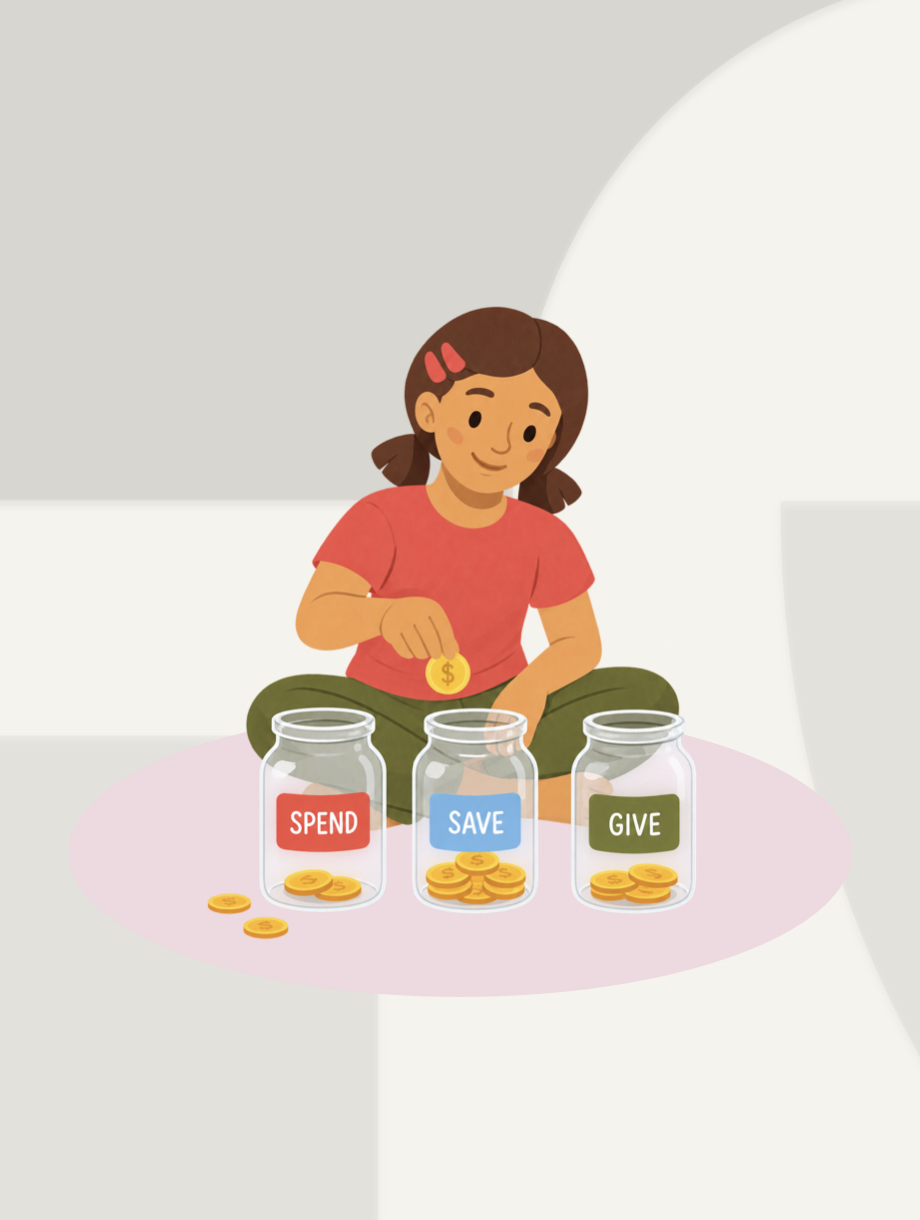
A child walks into a store with ten dollars and a hundred dollars’ worth of wants.
Suddenly, money gets interesting.
The toy they wanted yesterday competes with the candy in front of them today. Something has to wait. Something has to stay on the shelf. And for perhaps the first time, “Can I have it?” becomes “Is this how I want to use my money?”
That is a financial education moment. You do not need a classroom to create it.
At TheMoneyBooks, we believe understanding how money works should begin long before the first paycheck. One place to start is with three simple containers labeled Spend, Save, and Give.
Give Every Dollar a Job
There is nothing wrong with a piggy bank. Putting money aside is a useful habit. But dropping coins through a slot does not automatically teach a child how to make decisions with them.
Three jars bring those decisions into view.
Some money is for enjoying now. Some is for something worth waiting for. Some is for helping someone else.
When children receive an allowance, birthday money, or earnings from an agreed extra task, help them divide it among those purposes. Choose a split that fits your family. Ten dollars might become five for spending, four for saving, and one for giving.
The amounts can be smaller. The conversation still matters.
Let your child count the money and make the deposits. Ask what each portion will do. Give them enough ownership to feel that their decisions matter, because they do.
The Spend Jar: Learning to Choose
Parents spend years saying, “We’re not buying that.” The spend jar gives children a chance to understand why every purchase cannot be a yes.
Imagine your child spends their available money on a toy that loses its appeal by dinner. Two days later, they discover something they want more.
Your instinct may be to cover the difference. Instead, when it is a nonessential purchase, let the limit stand.
Be kind. There is no need for “I told you so.” Ask, “How do you feel about what you bought? What might you do differently next time?”
A disappointing purchase can become useful experience when the stakes are small.
Keep necessities separate. Children should not have to worry that a spending mistake means going without lunch or school supplies.
The lesson is that choosing one thing sometimes means passing on another. That understanding will matter when the choices get bigger.
The Save Jar: Making Waiting Visible
“Save your money” is an instruction. “Let’s work toward that bike” gives the instruction a purpose.
Help your child pick a realistic goal, find its price, and figure out how much they can set aside regularly. A sixty dollar goal funded with five dollars a week takes twelve weeks, assuming no additional contributions or price changes.
For a child, that can feel like forever.
Make progress visible. Put a picture of the goal beside the jar. Draw a chart they can color as their savings grow. Count together and celebrate milestones without buying rewards that overshadow the goal.
When another temptation appears, help them compare it with what they are working toward. They may decide the new purchase matters more. That is a conversation, too.
Eventually, reaching the goal connects repeated effort with a result they can touch. The purchase carries a story: “I worked toward this. I made it happen.”
The Give Jar: Practicing Generosity
Money lessons can become a constant conversation about what we want. The give jar makes room for someone else.
Ask your child what they care about. Animals? Families who need groceries? A community project? Help them explore an appropriate way to contribute.
Then involve them in the choice and, when possible, the action. Buying supplies for a shelter can make giving more understandable than watching an adult click a donation button.
Talk about dignity. People receiving help deserve respect and privacy. Generosity does not need an audience, and a small gift does not need an apology.
For families with little money to spare, time and effort belong in this conversation as well. Children can help, share, and serve without being taught that kindness depends on how much cash they have.
Let Them See Your Decisions
The jars become more meaningful when children hear how adults make similar choices.
At the grocery store, explain why you are comparing prices. Before an outing, talk about what you have set aside for it. When saving for something, share an age appropriate version of the goal.
Try saying, “We could buy that, but we’re choosing to use that money for something else.”
You do not have to share account balances or adult financial worries. You can show that money decisions involve thought, priorities, and tradeoffs.
You also do not have to pretend you have always gotten it right. “I wish I had learned this sooner” can open an honest conversation. Learning together is a better starting point than waiting until you feel like an expert.
Start Small. Keep Going.
Set aside a few minutes each week to check the jars together. What came in? What went out? Is the savings goal still meaningful? Where could the giving money help?
Keep it curious, not critical. As children grow, the containers can become account categories, and the conversations can expand to earning, banking, borrowing, and investing.
Three jars are a beginning, not a complete financial education. Their value comes from the repeated practice of making choices and discussing what happens next.
That is the opportunity behind TheMoneyBooks: helping families turn financial education into everyday conversations they can actually use.
Start now. Find three containers. Let your child label them. Put a little money on the table and ask what it could do.
You are helping your child practice for the day when the decisions are entirely theirs.
August Is Make-A-Will Month

Milestone #7 Is About More Than Money
When most people think about getting their financial life in order, their minds usually go first to the numbers. How much do I earn? How much do I owe? Am I saving enough? Am I making smart decisions with what I have?
Those questions matter. But eventually, another question becomes just as important:
What happens to everything I have worked for when I am no longer here to manage it?
That is why August, recognized as Make-A-Will Month, is a timely reminder to look beyond simply accumulating money and think about protecting what matters most. The American College of Trust and Estate Counsel encourages families to use the month as an opportunity to consider wills and other important documents that can help communicate their wishes and provide greater clarity for the people they love.
It also connects directly to one of the most important ideas in TheMoneyBooks.
Money Milestone #7: Protect Wealth
The earlier Money Milestones help build a stronger financial foundation. They are about learning how money works, protecting yourself, preparing for emergencies, managing cash flow, reducing financial vulnerabilities and building wealth over time.
But building wealth is not the finish line.
If you have worked hard to build something, you also need to think about how it will be protected, transferred and ultimately used according to your intentions.
Milestone #7 asks us to think beyond the question, “How much money will I leave behind?” It asks deeper questions. Who will receive what I leave? Who will be responsible for carrying out my wishes? Who will make important decisions if I cannot make them myself? Will my family know what I wanted? Will they know where important documents and information are located?
Those are not just legal questions. They are part of being financially prepared.
A Will Is About Clarity
A will is one of the most familiar tools associated with this conversation, but people often misunderstand who needs one. Wills are sometimes thought of as something only wealthy or elderly people need.
In reality, a will is fundamentally about providing instructions and clarity. It gives you an opportunity to communicate what you want to happen to certain property after your death, subject to applicable laws and any other legal arrangements you have in place.
For parents, the conversation can become even more important. Families may need to consider who they would want caring for minor children, who they would trust with important responsibilities and how they want certain assets handled for the benefit of their family.
Without appropriate instructions, the people you love may be left trying to make difficult decisions during an already difficult time.
Make-A-Will Month is a useful reminder to ask a very basic question:
Have you actually put your wishes in writing?
A Will May Be Only One Piece
Protecting wealth can involve much more than creating a will. Depending on your family, assets and circumstances, there may be other documents worth discussing with a qualified legal professional.
A trust, for example, may serve purposes that are different from a will and can help determine how certain assets are managed or transferred. A power of attorney may authorize someone to handle certain financial or legal matters if you are unable to do so yourself. Healthcare directives and healthcare powers of attorney can help communicate your medical wishes or identify who should make certain healthcare decisions if you cannot communicate them yourself.
The American College of Trust and Estate Counsel likewise emphasizes that wills, trusts, powers of attorney and healthcare directives can all play a role in preparing your affairs.
The point is not that everyone needs the exact same collection of documents.
The point is that financial education should help you recognize the questions you need to ask and know when it is time to involve the right professional.
That idea fits naturally with TheMoneyBooks. Financial education is not about becoming your own lawyer, accountant or financial professional. It is about understanding enough to make better decisions, recognize gaps and take appropriate action before a problem occurs.
Don't Forget Your Beneficiaries
Milestone #7 also means understanding that a will does not necessarily control every part of your financial life. Certain accounts, insurance policies and other financial products may have beneficiary designations that determine who receives those assets.
That means beneficiary reviews are another important part of protecting wealth.
Think about how much life can change over ten or twenty years. People get married. Children are born. Families grow. Relationships change. People divorce. A person originally named as a beneficiary may pass away. New accounts may be opened, new property acquired and new financial responsibilities created.
A designation made years ago may no longer reflect what you want today.
Protecting wealth is not necessarily something you do once and forget about. It deserves periodic attention as your life changes.
Could Your Family Find Everything?
There is also a practical part of Milestone #7 that has little to do with creating a legal document: organization.
Imagine someone you trust having to step into your financial life tomorrow.
Would they know where to begin? Could they locate your important documents? Would they know about your insurance coverage? Could they identify your major financial accounts? Would they know where your will or trust is stored? Would they know which attorney, accountant or other professional to contact?
Even a carefully prepared document has limited usefulness if no one knows it exists or where to find it.
Protecting wealth therefore includes creating clarity around the financial life you have built. That does not mean giving everyone access to sensitive passwords or private information. It means making sure the appropriate people know that important documents exist, where they are securely located and whom they should contact if something happens.
Your Legacy Is Bigger Than Money
This is where the idea of legacy becomes much bigger than an account balance.
Your legacy may be the home where your family created memories. It may be the education you worked to provide, the business you spent decades building, the causes you cared about or the people you wanted to help. It also includes the values and lessons you hoped to pass from one generation to the next.
And one of the greatest things you may be able to leave your family is clarity.
Clear documents. Clear beneficiaries. Clear instructions. Clear communication about your wishes.
Instead of leaving a financial puzzle for others to solve, you can take steps today to make things easier for the people who may one day have to carry out those wishes.
Make August Your Milestone #7 Month
Make-A-Will Month gives us a natural opportunity to revisit Milestone #7.
Ask yourself:
- Do I currently have a will?
- If I have one, when was it last reviewed?
- Has my family or financial situation changed since then?
- Are my beneficiary designations current?
- Do I have the appropriate documents if I become unable to make decisions for myself?
- Does someone I trust know where my important documents are located?
- Are my financial records organized well enough that my family could understand them?
You may not know the answers to all of those questions today, and you do not need to solve everything at once.
Financial education begins with knowing which questions to ask.
The Money Milestones are not simply about becoming better at money. They are about becoming more intentional with it. You work to earn it, manage it, protect it and build it.
Milestone #7 reminds us that another responsibility eventually follows: making sure what you have built can continue doing what you intended it to do.
That is what Protect Wealth is really about.
And Make-A-Will Month might be the perfect reminder to begin.
This material is provided for educational purposes only and is not intended to provide legal or tax advice. Laws and individual circumstances vary. Consult an appropriately qualified legal or tax professional regarding your specific situation.
Your Phone Is Ringing. But Is It Opportunity or a Scam?

How one phone call can change your financial future, and what every family should know
Your phone rings.
You glance at the screen. The number is not familiar.
Maybe it is a new client. Maybe it is your doctor’s office, a delivery driver, your child’s school, or a family member calling from someone else’s phone. Important calls do not always come from numbers we recognize, so you answer.
Then you hear a recorded voice:
“Congratulations! You’ve been pre-approved…”
Or:
“This is your second notice regarding your $1,400 Social Security stimulus.”
Or perhaps the familiar instruction:
“Press 9 now to be removed from our calling list.”
Most people have heard some version of these messages. They are so common that many of us hang up, block the number, and move on without giving them much thought.
But these calls are more than an inconvenience. They can affect our privacy, our peace of mind, and, in some cases, our financial future.
At TheMoneyBooks, we believe financial education is about more than learning how to earn, save, invest, and protect money. It is also about recognizing situations that can quietly put everything you have worked for at risk.
A Changing World
There was a time when a ringing telephone usually meant that a real person wanted to speak with you.
Today, technology has changed that.
Automated systems can place enormous numbers of calls in a short period of time. Caller ID can be manipulated to display a local area code or a number that appears to belong to a trusted business. Artificial intelligence can even imitate human voices, making fraudulent calls sound more personal and believable.
That is what makes modern scams so effective. They are designed to look familiar, sound urgent, and create just enough uncertainty to make you respond.
Sometimes the goal is obvious. The caller wants your credit card number, bank information, Social Security number, password, or payment. Other times, the caller may only be trying to confirm that your phone number belongs to a real person.
When you answer, speak, press a button, or follow the caller’s instructions, you may be signaling that the number is active. That can make it more valuable to marketers and scammers, leading to even more unwanted calls.
Why We Still Answer
It is easy to say, “Just do not answer unknown numbers.”
In real life, it is not always that simple.
A parent may be waiting for a call from a child’s school. A business owner may receive calls from new customers. Someone applying for a job may be expecting a recruiter. A family may be coordinating medical care for an older relative.
Scammers understand this uncertainty. They know we do not want to miss something important, and they use that hesitation to create an opening.
The problem is not that people are careless. Scams are often built around normal human behavior. We want to be helpful. We respond to urgency. We respect authority. We worry about consequences.
A well-designed scam can take advantage of all those instincts.
The Cost Is Not Only Financial
When people think about scams, they usually think about money lost. That is one of the greatest risks, but it is not the only one.
Unwanted calls interrupt family dinners, work meetings, quiet moments, and important conversations. They create anxiety every time an unfamiliar number appears. They make people suspicious of legitimate calls and may eventually cause them to stop answering altogether.
There is also an emotional cost. People targeted by scams may feel embarrassed or ashamed, even when the scam was carefully designed to deceive them. A scam may take only a few minutes to begin, but the consequences can last much longer.
Why Digital Safety Is Part of Financial Education
Financial literacy is not only about building wealth. It is also about protecting what you have already built.
A family may spend decades working, saving, paying down debt, purchasing a home, and preparing for retirement. One fraudulent transaction, stolen identity, or compromised account can undo years of progress.
That is why digital safety belongs in every financial education conversation.
Identity theft, phishing, fraudulent investment offers, fake charities, bogus loan approvals, government impersonation scams, and account-takeover attempts all have one thing in common: they try to separate you from your information, your money, or both.
The good news is that small habits can make a meaningful difference.
Six Habits That Can Reduce Your Risk
1. Do not press numbers to be removed from a call list
A robocall may tell you to press a number to speak with someone or stop future calls. Do not do it. Do not press a key, say “yes,” or continue the conversation. Simply hang up.
Engaging may confirm that your number is active.
2. Let unknown callers go to voicemail
Legitimate callers will usually leave a message. A doctor’s office, school, customer, business, or family member can explain why they called and provide a way to respond.
Voicemail gives you time to listen, think, and verify before taking action.
3. Use the spam-protection tools on your phone
Most smartphones and wireless carriers offer features that help identify or filter suspicious calls.
Apple users can enable Silence Unknown Callers. Major carriers also offer tools such as AT&T ActiveArmor, Verizon Call Filter, and T-Mobile Scam Shield.
These tools may not stop every call, but they can provide another layer of protection between your family and a potential scammer.
4. Register with the National Do Not Call Registry
The registry will not stop criminals who ignore the law, but it can reduce legitimate telemarketing calls.
Reducing the overall number of unwanted calls may also make truly suspicious calls easier to recognize.
5. Never trust Caller ID by itself
A familiar name or local number does not prove that a call is legitimate.
When someone claims to represent a bank, government agency, utility company, or other organization, hang up and call back using a verified number.
Use the number on the organization’s official website, your account statement, the back of your card, or another trusted source.
Do not call a number provided by the suspicious caller.
6. Remember that urgency is often a tool
Scammers want you to act before you think.
They may say your account will be closed, your benefits will be suspended, your power will be disconnected, your family member is in danger, or an opportunity will disappear.
Pause. Verify. Then act.
A legitimate organization will allow you to confirm what is happening instead of pressuring you into an immediate financial decision.
The Same Rules Apply to Text Messages
Scam texts have become just as common as scam calls.
A message may claim that you have won a prize, missed a package delivery, qualified for a government payment, received a job offer, or need to solve an urgent account problem. It may include a link and tell you to act immediately.
If you were not expecting the message, do not click.
A link can lead to a fake website designed to collect your password, account information, or payment details.
Report the message as spam and delete it when possible. When it claims to be from a company you use, open the company’s official app or website separately instead of clicking the link.
The same principle applies to suspicious emails. Do not allow an alarming subject line, urgent warning, or unexpected offer to make the decision for you.
Slow down and verify the message independently.
Protecting Your Greatest Financial Asset
Many people would say their greatest financial asset is their home, retirement account, business, or investment portfolio.
Those things are important. But your identity may be even more valuable.
Your identity connects you to your bank accounts, credit history, tax records, insurance, benefits, email, phone number, and online accounts. Once someone gains access to enough personal information, the damage can spread quickly.
Protecting your identity does not mean living in fear. It means building habits that allow you to use technology without becoming an easy target.
That includes slowing down when a message feels urgent, verifying before sharing information, protecting access to your phone and email, and talking openly with family members about common scams.
These conversations matter across generations. Everyone can benefit from the same basic rule:
Stop, verify, and protect your information.
Financial education should be shared throughout the family. Talk about suspicious messages before someone receives one. Discuss what a bank, government agency, or legitimate business would and would not ask for over the phone.
Make it normal for family members to ask for help before sending money, sharing information, or clicking a link.
A few minutes of conversation today could prevent a costly mistake tomorrow.
A Better Response to the Next Call
The next time your phone rings from an unfamiliar number, you do not have to panic.
You also do not have to answer immediately.
Let the call go to voicemail.
Listen carefully.
Verify the caller independently.
Do not allow fear, curiosity, or urgency to make the decision for you.
Financial independence is not achieved only by making good investment decisions. It is also preserved by avoiding costly mistakes.
Every unwanted call you ignore, every suspicious text you delete, and every fraudulent message you report is another step toward protecting the future you have worked so hard to build.
Knowledge remains one of the most valuable investments you will ever make.
At TheMoneyBooks, our goal is to help individuals and families understand how money works, make informed decisions, and protect what matters most.
Because financial education is not only about creating a better future.
It is also about keeping that future secure.
Financial Habits to Teach Your Kids This Summer

Starting Financial Literacy Early Can Be Simpler Than You Think
Summer is a perfect season for kids to learn about money because life slows down just enough for families to turn everyday moments into teachable ones. Money lessons don't have to feel like lectures. In fact, the best ones usually happen at the grocery store, on vacation, while earning an allowance, or when a child is deciding whether to spend birthday money now or save it for something better later.
This summer, kids have something they don't have much of during the school year: time. Time is the most powerful asset young students have. No matter how old your child is, every student can use the summer to build money habits before the next school year begins.
Here are five money lessons every child can benefit from learning this summer, and simple ways parents can help them practice.
Money Mindsets Are Built Early
You don't have to wait until your child gets their first paycheck to start teaching money lessons. A child's money mindset often begins forming during their elementary school years.
Remember hearing phrases like, 'Money doesn't grow on trees' or 'We can't afford that'? Whether we realize it or not, young children are constantly listening and forming viewpoints about money from their parents. Kids learn from what we say, how we spend, and even how we react to financial stress.
Many of the beliefs we carry about money as adults started long before we ever earned our first dollar. That's why it's important to introduce positive money conversations early on. These conversations can start by teaching your kids how money is a tool, goals are worth planning for, and that opportunities often come from helping others.
Summer Challenge: Start a family money conversation each week. Talk through a real-life financial decision, such as whether to buy a new gaming subscription, how you're saving for a family vacation, or why you chose one purchase over another. This tremendously helps kids have open conversations around money and build a positive money mindset.
Saving Today Creates More Choices Tomorrow
Today, kids are learning the power of buying through instant gratification. With the click of a button, toys, clothes, and even food can be delivered to their doorstep the same day. While convenience has its benefits, it can also make it harder for kids to understand the value of patience, planning, and delayed rewards.
Instant gratification isn’t necessarily bad. In many ways, technology has made life easier and more efficient. The challenge is making sure convenience doesn't replace intentional decision-making. Convenience is a wonderful tool, but it shouldn't become a financial habit.
Summer Challenge: Help your child choose something they genuinely want to buy by the end of the summer, then create a savings plan together. Track their progress each week and celebrate the milestones along the way.
The lesson isn’t to save enough money to make the purchase—it's about learning patience, discipline, and how to plan ahead. The waiting period is where the lesson happens.
Small Habits Create Big Results
Before kids learn how to save and invest money, they should learn how to earn it. For example, as many middle schoolers are already thinking about what they want to be when they grow up, a summer job can be the perfect way to help them explore new skills, interests and valuable money lessons along the way.
Summer Challenge: A fun summer challenge for your middle schooler is encouraging your child to start a small business such as pet sitting, washing cars, lawn care, or house sitting while neighbors are away on summer vacation.
Not only will they earn money, but they'll also learn the responsibility of providing a service or serving others in exchange for an income—a lesson that can shape how they approach work and opportunity for years to come.
Time is One of Your Greatest Financial Assets
Many high school students earn their first real paycheck during the summer. This creates the perfect opportunity to teach them how banks, savings accounts, and budgeting work. It's also the ideal time to introduce concepts like the Rule of 72 and compound interest, showing them how their money can either grow over time or remain idle.
High school students have an opportunity to understand money concepts now that many people don't discover until much later in life. The difference between starting good money habits at 18 versus 31 can be hundreds of thousands of dollars over a lifetime.
That's the power of time and consistency working together.
Summer Challenge: Ask your high schooler to research a career they're interested in and find the average starting salary. Then, have them create a realistic monthly budget based on that income, including expenses like housing, transportation, groceries, insurance, and savings.
This lesson can show them how to connect today’s financial decisions to the lifestyle and future they want to build.
Financial Independence Requires Preparation
College is often the first time young adults make financial decisions without a parent looking over their shoulder.
For students heading to college this fall, the financial decisions they make over the next few years can impact them long after graduation. Before signing student loan paperwork or accepting credit card offers, they should understand how debt works, how credit scores are built, and how financial habits influence future opportunities.
Summer Challenge: Before move-in day, sit down with your college student and create a simple financial game plan for their first year. Learn what qualifies as a good, very good, and excellent credit score, and discuss how to build credit responsibly.
Credit impacts much more than borrowing money—it can affect the ability to rent an apartment, buy a car, or qualify for favorable loan rates post-graduation. Spending a few hours preparing this summer can help your student avoid financial mistakes that could take years to undo.
The Opportunity of Summer
The best time to teach money isn't after a financial mistake, it’s before one happens.
After all, the goal isn't simply to raise wealthy kids. The goal is to raise capable adults who understand how their money works, make informed financial decisions, and feel confident managing whatever life throws their way.
The conversations you have and the money lessons you teach your student this summer can help lay the foundation for a lifetime of financial success.
Christa Mathews, CFEd®
Your Credit Report Can Shape Your Financial Future

A Look At What Families Should Understand About Credit Today
Most people know they have a credit score.
Fewer people understand what is actually inside the credit report that helps create that score.
That is where the problem begins.
Your credit report is not just a number. It is a financial record that can influence whether you get approved for a mortgage, auto loan, credit card, apartment, or other major financial opportunity. Depending on the situation and applicable law, credit reports may also be used for insurance, employment, rental housing, and other permissible purposes. Employers must generally have written consent before accessing a credit report for employment purposes.
We believe financial literacy starts with awareness. You cannot protect what you do not understand. You cannot improve what you do not check. And you cannot teach your family how money works if credit remains a mystery.
So, did you know?
Did You Know Medical Debt Rules Are Not as Simple as the Headlines Made Them Sound?
You may have heard that medical debt was being removed from credit reports.
That was partly true for a moment, but the story changed.
In January 2025, the Consumer Financial Protection Bureau finalized a rule that would have removed medical bills from credit reports used by lenders. But on July 11, 2025, the U.S. District Court for the Eastern District of Texas vacated that rule. That means there is not currently a nationwide federal ban removing all medical debt from credit reports.
That matters because many families may assume medical debt can no longer affect their credit. That is not always true.
Here is what consumers should know: the three major credit reporting companies, Equifax, Experian, and TransUnion, made voluntary changes that still matter. Paid medical collections were removed from consumer credit reports. Medical collections less than one year old were removed. Medical collections under $500 were also removed.
But unpaid medical collections over $500 may still appear after the waiting period.
The lesson is simple: do not ignore medical bills just because you heard “medical debt is gone.” Review your bills. Ask questions. Request itemized statements. Check insurance adjustments. Dispute errors. And review your credit reports to make sure outdated or incorrect medical collections are not still sitting there.
Financial literacy is not just knowing the rule. It is knowing how the rule applies to your life.
Did You Know Student Loan Late Payments Can Show Up Again?
For many borrowers, student loans felt paused for so long that it became easy to forget how much they can affect credit.
But federal student loan delinquency reporting has returned. According to the Federal Reserve Bank of New York, missed student loan payments were not reported during the 12-month “on-ramp” period through October 2024, but the first student loan delinquencies began appearing on credit reports during the first quarter of 2025. Federal student loan default generally takes 270 days of missed payments, which is why new defaults began appearing on credit reports later, in the fourth quarter of 2025.
That can be a major wake-up call.
A missed student loan payment does not just stay between the borrower and the loan servicer. Once reported, it can become part of a credit history. That history can affect future borrowing, housing decisions, and the cost of credit.
TheMoneyBooks message is not shame. It is strategy.
If you are struggling, do not wait until the problem becomes serious. Contact your loan servicer. Ask about repayment options. Get clarity on due dates. Put reminders in place. Make sure your contact information is updated. Small steps early can help prevent bigger financial damage later.
Credit is not about perfection. It is about patterns.
Did You Know Buy Now, Pay Later May Not Stay Invisible?
Buy Now, Pay Later services made spending feel easier.
Split the purchase. Make a few payments. Move on.
But the financial world is catching up.
FICO has created FICO Score 10 BNPL and FICO Score 10T BNPL, newer scoring models designed to incorporate Buy Now, Pay Later data when that data is furnished to credit bureaus at scale. FICO says broader use will grow over time as more BNPL data is reported and more institutions begin using those scores.
That does not mean every BNPL purchase affects every credit score today. It also does not mean every lender is using those newer models right now.
But it does mean the direction is clear: more financial behavior may become visible over time.
That is important for families and young adults.
A small payment plan can feel harmless. But several small payment plans at the same time can become a cash flow trap. When those payments stack up, they can make it harder to pay bills, save money, or avoid high-interest debt.
The question is not just, “Can I afford this payment?”
The better question is, “What is this doing to my overall financial picture?”
That is how financially literate people think.
Did You Know Mortgage Credit Scoring Is Changing Too?
Buying a home is one of the biggest financial decisions most families will ever make. Credit scoring plays a major role in that process.
For decades, mortgage loans delivered to Fannie Mae and Freddie Mac generally relied on the Classic FICO model. FHFA is now allowing an interim phase where approved lenders may choose between Classic FICO and VantageScore 4.0 for loans sold to Fannie Mae and Freddie Mac. FHFA also says FICO 10T remains approved and is planned for future use by the Enterprises.
Why does this matter?
Because not all credit scores are the same. Different models may weigh information differently. Some newer models may consider additional data sources, including rent payment history when it is available and reported.
That means a person who only looks at one score in one app may not be seeing the same score a lender sees.
This is why credit education matters before someone applies for a mortgage, not after.
Families should understand their reports, manage balances, pay on time, avoid unnecessary debt, and prepare months in advance before making a major borrowing decision.
Hope is not a homebuying strategy. Preparation is.
Did You Know You Can Check Your Credit Reports Every Week for Free?
This may be one of the most important financial literacy facts of all.
The three nationwide credit bureaus have permanently extended free weekly credit reports through AnnualCreditReport.com. The Federal Trade Commission identifies AnnualCreditReport.com as the official site for free credit reports.
That means you do not have to guess what is on your report.
You can check.
You can look for accounts you do not recognize. You can review collection items. You can confirm whether payments are being reported correctly. You can catch errors before they become expensive. You can protect yourself from identity theft.
Your credit report is one of the most important financial documents connected to your name. Yet many people only look at it after something goes wrong.
That needs to change.
Did You Know Credit Reports and Credit Scores Are Not the Same Thing?
This is one of the biggest misunderstandings in personal finance.
Your credit report is the record. Your credit score is a calculation based on information in that record. The FDIC explains that a credit report is a record of current and past debts, including payment history, while a credit score is a number based on information available in the credit report.
Think of it like school. The report is the homework, quizzes, attendance, and test history. The score is the grade calculated from that information.
If the report has errors, the score may suffer.
If the report shows late payments, high balances, collections, or too many new accounts, the score may suffer.
If the report shows consistent payments, responsible balances, and long-term credit management, the score may improve.
That is why TheMoneyBooks focuses on education first. People do not need more financial confusion. They need clear explanations that help them make better decisions.
The Bigger Lesson: Credit Is a Reputation System
Credit is not just about borrowing money.
It is about financial trust.
Lenders use credit reports to ask, “Has this person shown a pattern of paying what they owe?”
Landlords may use credit-related information to ask, “Is this person financially reliable?”
Insurance companies, employers, and other institutions may use certain credit-related information depending on the situation and applicable laws.
That may not feel fair, especially when medical bills, student loans, inflation, and emergencies are involved. But ignoring the system does not protect you from it.
Understanding the system gives you power.
That is the heart of financial literacy.
What Should You Do Now?
Start with these simple steps:
Check your credit reports from all three major bureaus.
Look for medical collections that should not be there.
Confirm student loans are current, or contact your loan servicer before the issue gets worse.
Be careful with Buy Now, Pay Later plans, especially if you are juggling several at once.
Keep credit card balances low compared with limits.
Pay every bill on time whenever possible.
Dispute inaccurate information.
Teach your children that credit is not free money. It is borrowed trust.
And if your situation feels complicated, talk with a financial professional. Credit issues, debt, student loans, mortgage preparation, budgeting, insurance planning, and long-term financial decisions often connect to one another. A financial professional can help you look at the bigger picture, understand your options, and build a plan that fits your goals.
Our mission is to help families understand how money really works, because the people who understand the rules are better prepared to play the game.
Credit reporting may feel complicated, but the principle is simple:
What gets reported can affect what opportunities you receive.
So do not wait for a declined application, a higher interest rate, or a surprise collection notice to start paying attention.
Did you know your credit report could shape your financial future?
Now you do.
And now you can do something about it.
Inflation Is More Than a Number

The Price of Everything Has Changed
Inflation has become one of those financial words everyone hears, but not everyone fully understands. We feel it at the grocery store. We feel it at the gas pump. We feel it when insurance renews, when rent goes up, when eating out costs more, and when a simple family outing seems to cost twice what it used to.
But what is “normal” inflation? How is today’s inflation different? And most importantly, what can families do to protect themselves as much as possible?
We believe financial literacy starts with understanding the forces that affect your everyday life. Inflation is one of the biggest.
What Is Inflation?
Inflation is the rise in prices over time. It means your dollars do not buy as much as they used to.
If a basket of groceries cost $100 last year and that same basket costs $104 this year, prices went up by 4%. That does not necessarily mean you bought more. It means the same money now buys less.
Inflation is not just about one item getting more expensive. It is about the overall cost of goods and services increasing across the economy.
What Is Considered “Normal” Inflation?
In the United States, the Federal Reserve generally aims for inflation of about 2% over the long run. That means prices are expected to rise slowly and steadily.
A little inflation is considered normal in a growing economy. When inflation is low and stable, families, businesses, and investors can plan more confidently. Wages, prices, savings, loans, and long-term goals are easier to manage when inflation is predictable.
At 2% inflation, prices still rise, but usually at a pace that feels more manageable.
For example, something that costs $100 today would cost about $102 one year later if inflation were 2%.
That is normal inflation.
Today’s Inflation Feels Different
Today, many families are dealing with inflation that is higher than the long-term target. Recent data shows that overall consumer prices are rising faster than the 2% level many economists consider stable.
That is why so many people feel squeezed.
Even when inflation slows down, prices usually do not go back to where they were. Slower inflation does not mean groceries, rent, insurance, and utilities suddenly become cheap again. It usually means prices are rising more slowly than before.
That is an important difference.
If prices rose sharply for several years and then inflation slows, families may still be stuck with the higher price level. The monthly bill does not reset. The grocery receipt does not go back in time. The insurance premium does not automatically shrink.
That is why people can hear that inflation is “cooling” and still feel like everything is too expensive.
Why Everything Seems to Cost More
Inflation does not hit every part of life equally. Some categories rise faster than others, and those are often the things families cannot easily avoid.
Food, shelter, transportation, energy, insurance, medical care, and household essentials are not luxuries. They are part of everyday life.
When these costs rise, families have fewer options. You can skip a vacation. You can delay a new purchase. But you still need groceries. You still need housing. You still need transportation. You still need insurance. You still need to keep the lights on.
That is why inflation can feel so personal.
It does not just affect numbers on a government report. It affects decisions around the kitchen table.
Inflation Is a Hidden Tax on Your Future
Inflation quietly reduces purchasing power.
If your income does not rise as fast as your expenses, you are effectively falling behind, even if your paycheck stays the same. A stable paycheck can feel like a pay cut when everything around you costs more.
The same is true for savings.
Money sitting in a low-interest account may feel safe, but if it earns less than the inflation rate, its buying power is shrinking over time. You may still have the same number of dollars, but those dollars may not stretch as far.
That is why inflation is not just a short-term budgeting issue. It is also a long-term wealth issue.
What Can You Do to Mitigate Inflation?
You cannot control the national inflation rate. But you can control how you prepare, respond, and adjust.
Here are several practical steps families can take.
1. Know Your Real Monthly Number
Most people know what they earn. Fewer people know exactly what they spend.
Start by identifying your real monthly cost of living. Look at housing, food, utilities, transportation, insurance, debt payments, subscriptions, childcare, giving, savings, and irregular expenses.
Inflation often hides in small increases. A few dollars more here, a higher bill there, a renewal that quietly jumps, and suddenly your budget feels tight.
You cannot fight what you do not measure.
2. Separate Needs, Wants, and Leaks
Inflation makes it more important to know the difference between needs, wants, and leaks.
Needs are the essentials. Wants are choices. Leaks are expenses that do not bring enough value to justify their cost.
Subscriptions you forgot about, delivery fees, unused memberships, impulse purchases, and convenience spending can quietly drain hundreds of dollars a month.
Cutting leaks does not mean living with less joy. It means making sure your money is going where it matters most.
3. Shop With a Strategy
When prices rise, shopping habits matter more.
Plan meals before grocery shopping. Compare unit prices. Use store brands when quality is similar. Buy household staples in bulk when it truly saves money. Reduce food waste. Use loyalty programs wisely. Avoid shopping when rushed, hungry, or emotional.
Small improvements repeated every week can make a meaningful difference over a year.
4. Review Insurance, Utilities, and Recurring Bills
Many families focus only on groceries, but some of the biggest savings may be hiding in recurring bills.
Review auto insurance, home insurance, cell phone plans, internet, streaming services, software subscriptions, gym memberships, and utility usage.
You may not be able to eliminate every increase, but you may be able to reduce the impact.
Call providers. Ask for better rates. Compare options. Remove services you no longer use. Adjust plans that no longer fit your life.
Inflation rewards people who review their expenses regularly.
5. Build an Emergency Fund
Higher prices make emergencies more expensive too.
A car repair, medical bill, appliance replacement, or unexpected trip can hurt more when the cost of everything has gone up.
An emergency fund gives your family breathing room. It helps you avoid using high-interest debt when life happens.
Start with a small goal if needed. Even $500 or $1,000 can create a buffer. Then work toward one month of expenses, then three to six months over time.
The goal is not perfection. The goal is progress.
6. Be Careful With High-Interest Debt
Inflation can push families toward credit cards, personal loans, and buy-now-pay-later plans just to keep up.
That can create a dangerous cycle.
When prices rise and interest piles on top, the cost of yesterday’s purchases can crowd out tomorrow’s choices.
If you have high-interest debt, make a plan to reduce it. Focus on paying more than the minimum when possible. Consider consolidating only if it truly lowers your cost and does not encourage more borrowing.
Debt can make inflation feel even heavier.
7. Increase Your Income When Possible
You can only cut so much. At some point, income matters.
Consider asking for a raise, improving your skills, taking on additional work, starting a side business, or finding ways to turn existing knowledge into income.
The goal is not simply to work more. The goal is to make your financial life more resilient.
If inflation raises the cost of living, your income strategy must also grow.
8. Keep Long-Term Money Working
Inflation is one reason long-term planning matters.
Money needed soon should generally be kept accessible and protected. But money intended for long-term goals may need the opportunity to grow over time.
That could include retirement accounts, diversified investments, business ownership, real estate, or other long-term strategies depending on your situation, risk tolerance, and goals.
The key is this: money that never grows may struggle to keep up with a world where prices rarely stop rising.
9. Teach Your Family How Money Really Works
Inflation is not just an adult issue. It is a family education issue.
Children and teens see prices rising too. They notice when eating out costs more, when trips are more expensive, and when parents say no to things they used to say yes to.
Use inflation as a teaching moment.
Explain purchasing power. Talk about saving, spending, giving, earning, and investing. Show them how choices matter. Help them understand that money is a tool, and learning how it works gives them more options in life.
The Bottom Line
Normal inflation is low, steady, and manageable. Today’s inflation has been higher, more noticeable, and more painful for many families because it touches the things people need most.
You cannot control the price of groceries, gas, insurance, rent, or utilities. But you can control your awareness, your habits, your plan, and your financial education.
Inflation may raise the cost of living, but financial literacy can raise your ability to respond.
The more you understand how money works, the better prepared you are to protect your family, make wise decisions, and build a stronger financial future.
That is why TheMoneyBooks exists: to help people learn the money lessons they should have been taught long ago.
Popular Money-Saving Hacks That Don’t Actually Work

Why real savings starts with financial literacy, not shortcuts
Everyone loves a good money-saving hack.
Clip this coupon. Cancel that subscription. Buy in bulk. Make coffee at home. Skip the avocado toast. Use this app. Follow this trick. Try this challenge.
Some of these ideas can help. A few dollars here and there can matter. But the problem is that many “money-saving hacks” sound smart while doing very little to change the bigger picture.
They create the feeling of progress without always producing real progress.
At TheMoneyBooks, we believe financial literacy begins with learning how money actually works. That means looking past the trendy tips and asking better questions. Is this really saving me money? Is it changing my habits? Is it helping me build long-term stability? Or is it just making me feel better while the real leaks in my financial life keep draining me?
Here are some popular money-saving hacks that often do not work as well as people think.
1. Buying Something Because It’s “On Sale”
A sale only saves money if you were already going to buy the item and the price is truly lower than usual.
That sounds obvious, but retailers know how powerful a discount sign can be. “Limited time.” “Clearance.” “Buy one, get one.” “Today only.” These phrases create urgency. They make you feel like you are missing out if you do not act now.
But spending $60 instead of $100 is not saving $40 if you did not need the item in the first place. You still spent $60.
This is one of the oldest traps in consumer behavior. The discount becomes the justification. The bargain becomes the excuse.
A better question is: “Would I still buy this if it were full price?”
If the answer is no, the sale may not be saving you money. It may be selling you something you never planned to buy.
2. Buying in Bulk Without a Real Plan
Bulk buying can be useful. It can also become a very expensive way to waste money.
Warehouse clubs and bulk stores can make people feel financially responsible. Bigger package. Lower unit cost. More value. But the math only works if you actually use what you buy.
If the food expires, the toiletries pile up, or the “deal” encourages you to consume more than you normally would, the savings disappear.
Buying 48 snacks may cost less per snack, but if your family eats them twice as fast because they are sitting in the pantry, did you really save money?
The key is not the size of the package. The key is the behavior attached to it.
Bulk buying works best for predictable, repeat-use items. It works poorly for impulse purchases, perishable foods, or products you are trying for the first time.
A lower unit price is not a win if the total purchase pulls money away from more important priorities.
3. Chasing Points, Rewards, and Cash Back
Credit card rewards can feel like free money. Points, miles, perks, and cash back all sound like smart financial tools.
But rewards only work when the cardholder is disciplined enough to avoid carrying a balance and avoid spending more just to earn rewards.
The trap is simple: people may spend $100 to earn $2 back, then feel like they made a smart move. But if that purchase was unnecessary, the reward did not create value. It softened the regret.
Rewards should never become the reason to spend.
A 2% reward does not cancel out a 24% interest rate. That is where financial literacy matters. If interest is working against you, the rewards are usually not the main story. The main story is the cost of carrying debt.
This is where the Rule of 72 becomes powerful. It helps people see how quickly money can double, either for them or against them. High-interest debt can grow with shocking speed. Small rewards are no match for aggressive compounding in the wrong direction.
4. Cutting Small Joys While Ignoring Big Leaks
The “make coffee at home” advice is not wrong. Small habits can add up. But sometimes people focus so hard on tiny expenses that they ignore the larger financial decisions quietly costing them far more.
They feel guilty about a $5 coffee but do not review their subscriptions. They skip a lunch out but keep paying high interest on credit cards. They hunt for grocery coupons but never compare insurance costs, phone plans, unused memberships, or bank fees.
This creates emotional exhaustion. People begin to associate money management with constant deprivation.
The goal is not to remove every small joy from life. The goal is to understand where the biggest leaks are.
A strong financial life is not built only by saying no to coffee. It is built by knowing what is happening with your money, where it is going, what it is costing you, and whether your choices are moving you closer to freedom or further away from it.
5. Downloading Budgeting Apps Without Changing Behavior
Budgeting apps can be helpful. They can show spending, organize categories, connect accounts, and create awareness.
But an app cannot care about your future for you.
Many people download a budgeting app expecting clarity, then feel disappointed when the app simply shows them what they already suspected: money is coming in, money is going out, and the pattern is not working.
Information alone does not create transformation.
A budgeting app can show you the numbers. Financial literacy helps you understand what those numbers mean.
That is the difference.
Without education, a dashboard can become another place to feel overwhelmed. With education, the same dashboard can become a tool for better decisions.
The app is not the answer. The knowledge behind the app is what gives it power.
6. Doing No-Spend Challenges Without Solving the Real Problem
No-spend challenges can be motivating. A week or a month of reduced spending can help people reset and become more aware of their habits.
But many no-spend challenges fail because they are temporary.
People pause spending for 30 days, then reward themselves afterward by spending even more. The challenge becomes a financial diet: intense restriction followed by rebound behavior.
The real goal should not be temporary restriction. The real goal should be permanent awareness.
Why do I spend the way I spend? What triggers unnecessary purchases? Am I spending from boredom, stress, comparison, convenience, or lack of clarity?
Without answering those questions, a no-spend challenge may only delay the same problem.
The best money changes are not built on shame. They are built on understanding.
7. Choosing the Cheapest Option Every Time
Cheap is not always wise.
Sometimes the cheapest option costs more over time. Cheap shoes wear out faster. Cheap tools break. Cheap repairs need to be redone. Cheap services create bigger problems later.
This does not mean expensive is always better. It means price and value are not the same thing.
A financially literate person learns to ask, “What is the real cost?”
That includes money, time, quality, risk, frustration, and replacement cost.
Buying the cheapest option may feel like saving money today, but if it creates a larger expense tomorrow, it was not really a savings strategy. It was a delay.
The Hack That Actually Works
The best money-saving “hack” is not really a hack at all.
It is literacy.
When you understand how money works, you stop being so easily influenced by discounts, trends, apps, points, shortcuts, and pressure. You begin to see the bigger picture.
You learn the difference between saving money and avoiding spending. You learn the difference between looking smart and making wise decisions. You learn how debt compounds, how habits form, how small decisions accumulate, and how financial confidence is built.
That is the heart of TheMoneyBooks.
The goal is not to make people feel guilty about every purchase. The goal is to help people wake up. Because once you understand the rules of the game, you are much less likely to be played by it.
Popular hacks may help around the edges.
But financial literacy changes the foundation.
And when the foundation changes, everything else can change with it.
The Money Talk You Shouldn't Avoid

It May Be the Talk That Brings You Closer Together
Money may be one of the most important subjects in a relationship, but for many couples, it is also one of the hardest to bring up.
Not because people do not care.
Usually, it is because they care a lot.
They care what their spouse thinks. They care about being judged. They care about being misunderstood. They care about what the conversation might reveal: debt, fear, habits, mistakes, different values, or different expectations about the future.
A recent study published in the journal Social Psychological and Personality Science, titled “Couples Underestimate Positive Affective Reactions to Financial Conversations,” found that romantic partners tend to underestimate how enjoyable, informative, and socially connecting financial conversations can be. In other words, many couples expect money talks to go worse than they actually do.
Lead author Dr. Ximena Garcia-Rada, who serves as an assistant professor at Mays Business School at Texas A&M University, summarized the finding this way: couples often underestimate how likely they are to find common ground when they talk about money. The study was based on three diary studies involving nearly 1,900 married U.S. adults who predicted how a financial conversation would go, then reported how it actually felt afterward.
That should get our attention.
Because if money conversations usually go better than expected, then silence may be costing couples more than conflict ever would.
Money Is Never Just Math
At first glance, money looks like numbers.
Income. Bills. Debt. Savings. Spending. Interest. Retirement. Insurance. Groceries. Gas. College. Mortgage. Credit cards.
But money is rarely just numbers.
Money often represents security. Control. Freedom. Love. Fear. Shame. Status. Childhood memories. Family expectations. Personal identity. The future someone hoped for. The future someone fears they may never reach.
That is why two people can look at the exact same financial situation and feel completely different emotions.
One person sees a budget and feels trapped.
The other sees a budget and feels safe.
One person sees debt and feels embarrassed.
The other sees debt and wants to attack it immediately.
One person wants to spend because life is short.
The other wants to save because life is unpredictable.
Neither person is necessarily wrong. They may simply be speaking different money languages without realizing it.
This is one reason financial literacy matters so much. The goal is not merely to know more facts. The goal is to build a shared language.
When couples do not have that language, every financial conversation can feel personal. A question about spending feels like criticism. A question about saving feels like control. A question about debt feels like judgment.
But when couples begin to understand how money works, the conversation can shift from blame to teamwork.
The Fear Is Often Worse Than the Conversation
The researchers found that people consistently expected financial conversations with their romantic partners to be less positive than they actually were. After the conversations happened, participants reported that they were more enjoyable, informative, and emotionally connecting than expected.
That is a powerful insight.
Many couples are not avoiding money because the conversation is guaranteed to go badly. They are avoiding it because they imagine it will go badly.
They rehearse the argument before it happens.
They picture the criticism before it is spoken.
They assume disagreement means division.
But the study suggests something different: when couples actually sit down and talk, they often find more agreement than they expected.
That does not mean every money conversation is easy. It does not mean every couple will instantly agree. It does not mean difficult issues disappear.
But it does mean the first step may be less frightening than people think.
And that first step matters.
Because silence does not solve money problems. It usually lets them grow.
Financial Literacy Can Protect More Than Your Wallet
TheMoneyBooks were created around a simple belief: people deserve to know how money works.
Not because money is everything.
Because money touches almost everything.
It touches marriage. Parenting. Housing. Education. Retirement. Generosity. Stress. Opportunity. Choices. Dreams. Legacy.
When people lack financial literacy, they often make decisions in the dark. When couples lack financial communication, they may make those decisions separately, silently, or emotionally.
That is dangerous.
A couple does not need to agree on every financial detail to move forward. But they do need a shared understanding of the basics:
What is coming in?
What is going out?
What do we owe?
What are we building?
What are we protecting?
What matters most to us?
What do we want our money to do?
These are not just financial questions. They are life questions.
And when couples learn to answer them together, money can become less of a wedge and more of a window. It reveals values. It exposes priorities. It invites honesty. It creates a chance to build trust.
Start Smaller Than You Think
One reason people avoid money conversations is that they think the first talk has to solve everything.
It does not.
The first conversation does not have to be a full household financial review. It does not have to include every debt, every account, every mistake, every goal, and every fear.
Start with one simple question.
“What is one thing about money that has been on your mind lately?”
Or:
“What is one financial goal you wish we were making more progress on?”
Or:
“What did your family teach you about money growing up?”
Or:
“What purchase or bill has been stressing you out recently?”
The goal of the first conversation is not perfection. It is connection.
Listen first. Do not interrupt. Do not correct every detail. Do not turn the conversation into a courtroom.
A healthy money conversation is not one person prosecuting the other person’s habits. It is two people trying to understand the story behind the numbers.
Turn the Money Talk Into a Money Habit
The best time to talk about money is not only when something goes wrong.
That is one of the reasons money becomes so emotionally charged. If couples only talk about money during a crisis, the topic itself starts to feel like a crisis.
Instead, make the conversation normal.
A 20-minute weekly money check-in can do more than a three-hour argument every six months.
Keep it simple:
What bills are coming up?
What spending surprised us this week?
What progress did we make?
What needs attention?
What is one decision we should make together?
Over time, these conversations can lower fear because they create familiarity. The more often you talk, the less dramatic the topic becomes.
Financial literacy works the same way. You do not become financially literate in one giant leap. You build it concept by concept, conversation by conversation, decision by decision.
You Do Not Have to Figure It Out Alone
For many couples, the hardest part is not caring about money. It is knowing where to start.
That is where connecting with a financial educator can help.
A good financial educator can give couples a simple, judgment-free place to begin. They can help explain basic concepts, organize the conversation, identify common blind spots, and provide education around topics like debt, savings, protection, retirement income, and long-term goals.
Sometimes, an outside voice makes the conversation easier. It gives both people the chance to step back, look at the bigger picture, and learn together instead of feeling like they are on opposite sides of the table.
The goal is not to make people feel embarrassed about what they do not know. The goal is to help them see what is possible once they start learning.
Because when couples understand how money works, they can make more confident decisions together. They can ask better questions. They can build better habits. They can move from stress and silence to clarity and teamwork.
If money has been hard to talk about in your relationship, do not wait for a crisis to force the conversation. Start small. Start honest. And consider sitting down with someone who can help you learn the concepts and build a path forward.
Financial literacy changes more than bank accounts.
It can change conversations.
It can change relationships.
It can change lives.
Financial Literacy Month Is More Than Just Awareness

It Should Lead to Action
Understanding money is only the beginning. The real goal is helping people take the next step with clarity and confidence.
April is Financial Literacy Month.
That matters, but only if it leads somewhere.
Awareness alone does not reduce debt.
Awareness alone does not create a budget.
Awareness alone does not improve credit.
Awareness alone does not help a family feel more confident about money.
Action does.
Awareness Matters, but Action Changes Outcomes
And the encouraging thing is this: many Americans already seem to know that something needs to change.
According to a January 2026 report from the National Endowment for Financial Education, the most commonly chosen financial New Year’s resolutions for 2026 are paying down any type of debt (42%), setting and following a budget (39%), and checking and improving credit score (36%).
That list is important because it reveals what people are really looking for.
They are not chasing financial complexity. They are chasing clarity.
People Want Control Over the Fundamentals
They want to reduce pressure.
They want to understand where they stand.
They want to regain control.
They want to make better decisions.
That is exactly what financial literacy is supposed to produce.
At TheMoneyBooks, we believe financial literacy is not merely the ability to define terms. It is the ability to act with understanding. To make decisions with more wisdom. To stop drifting and start building.
That is why Financial Literacy Month should not end with information. It should lead to transformation.
Financial Education Should Change the Way People Live
The NEFE report also noted that financial education is proven to increase knowledge, build confidence, and support informed decision making. That may sound simple, but it is powerful. Because knowledge changes what people notice. Confidence changes what they are willing to face. And informed decision-making changes outcomes over time.
Those three things matter more than many people realize.
A person who understands debt sees it differently.
A person who understands budgeting approaches spending differently.
A person who understands credit uses it differently.
A person who understands financial planning thinks differently about the future.
That is the goal.
Not just to know more, but to live differently because of what you now understand.
There Is Progress, but There Is Still a Huge Gap
The good news is that there is momentum building around financial education. NEFE noted that in 2025, Kentucky, Colorado, Texas, and Delaware passed financial education graduation requirement bills. That brought the number of states that either require or are implementing at least a semester-long financial education course for graduation to 30. Including partial requirements, the total reached 38 states.
That is real progress.
It means more young people may enter adulthood with a stronger foundation than previous generations had. But it also highlights a major reality: millions of adults never received that education.
Too Many Adults Were Expected to Figure Money Out on Their Own
They were expected to figure money out on their own.
They learned by trial and error.
They learned after mistakes.
They learned under pressure.
They learned too late.
That is why Financial Literacy Month is not only about students. It is about everyone.
It is for the person who never learned how budgeting really works.
For the family trying to get out of debt.
For the worker who wants to understand how to make better decisions.
For the parent who wants to stop passing financial confusion to the next generation.
For the individual who is tired of feeling unsure every time money comes up.
This month is an invitation to stop guessing.
Many People Are Managing, but Not Thriving
The NEFE report found that respondents were most likely to describe the quality of their current financial life as about what they expected (41%), followed closely by worse than expected (38%), with only 16% saying better than expected. That means many people are not thriving financially. At best, many feel they are managing. At worst, they feel disappointed or behind.
That reality should not push people toward despair. It should push them toward education.
Understanding Creates Better Options
Because understanding money creates options.
It helps people identify what is not working.
It helps them recognize what needs to change.
It helps them prioritize.
It helps them make the next good decision instead of repeating the last costly one.
And that is how action begins.
Not with perfection.
With progress.
You Do Not Have to Know Everything to Begin
You do not have to know everything to move forward.
You do not have to fix everything in one month.
You do not have to become a financial expert overnight.
But you do need to begin.
That may mean reading something that finally makes money make sense.
It may mean looking honestly at debt.
It may mean reviewing your spending habits.
It may mean checking your credit.
It may mean having a real conversation with someone who can help guide you.
The Goal Is Clarity, Confidence, and a Next Step
This is why TheMoneyBooks exists. We want financial education to feel accessible, practical, and life-giving. We want people to understand that money is not supposed to remain a mystery. We want them to know that the confusion they feel is not proof they are incapable. Often, it is proof they were never taught.
And if you were never taught, the answer is not shame. It is learning.
That is what makes Financial Literacy Month so meaningful. It is a reminder that education can change direction. It can replace fear with understanding. It can replace passivity with action. It can replace confusion with confidence.
But only if people take the next step.
Let This Month Be a Turning Point
This month, let the goal be more than awareness. Let it be action.
Learn something.
Measure something.
Face something.
Change something.
Because financial literacy is not just about knowing more. It is about living with more clarity, more confidence, and more purpose.
And that kind of change can start today.
Call to Action
Make this Financial Literacy Month count. Take the Financial Literacy Quiz to see where you stand and where you can grow. Then connect with a financial educator who can help you turn understanding into action and build a stronger financial future.